Brakke’s samples: drops and capillarity
Liquid volumes against walls: contact angles, gravity, curved tanks, and the forces a liquid bridge exerts.
Each sample is run twice from its datafile: once with the recipe Brakke wrote into
it (its gogo command, or the usage its comments describe), once with a default
ev.relax() given as many refinements as the recipe does (levels). The table
shows the energy each ends with, the residual (how far from equilibrium, see
Relaxing a surface), the facet count, the time, and what relax()
reports: converged, stable, and any health issues. A lower energy on the same mesh
is not always the better answer: a coarse mesh can lower its energy in ways the
smooth surface can’t, so where an exact value is known, the error against it is
the measure. Times are from the documentation build and vary.
This gallery assumes Getting started and Relaxing a surface; its pages can be read in any order.
import numpy as np
import pyvista as pv
import pysurfaceevolver as pyse
import brakke_helpers as bh

pv.set_jupyter_backend("static")
mound.fe: a drop on a table
A drop of fixed volume on the plane \(z = 0\) with a contact angle (here 90 degrees, a
parameter) and gravity. The contact angle comes from an energy integral on the
contact line; the table top is drawn with fixed facets. re refines the contact line
only.
print(bh.recipe("mound.fe"))
runs = bh.compare("mound.fe")
bh.show(runs)
re; g 5; r; g 5; r; g 5; hessian; hessian;
| energy | residual | facets | seconds | converged | stable | notes | |
|---|---|---|---|---|---|---|---|
| recipe: re; g 5; r; g 5; r; g 5; hessian; hessian; | 3.846758904 | 3.1e-05 | 388 | 0.00 | |||
| relax(levels=2) | 3.846784259 | 2.1e-09 | 324 | 0.02 | yes | yes |
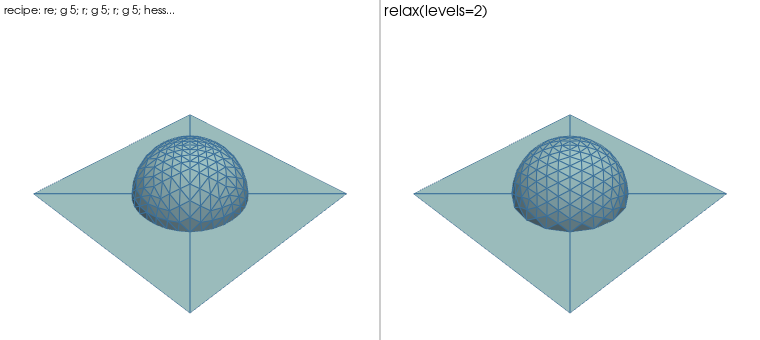
The recipe’s re refines the edges on the table first, so its mesh has more facets
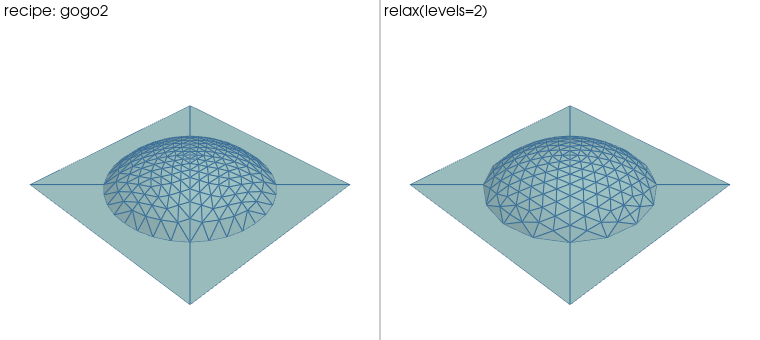
there; the energies agree to about 1e-5. The file’s other recipes change the contact
angle and gravity; gogo2 sets 45 degrees:
runs = bh.compare("mound.fe", "gogo2", levels=2,
                  setup=lambda ev: ev.parameters.update(angle=45))
bh.show(runs)
| energy | residual | facets | seconds | converged | stable | notes | |
|---|---|---|---|---|---|---|---|
| recipe: gogo2 | 1.875893082 | 4.1e-04 | 388 | 0.00 | |||
| relax(levels=2) | 1.876743459 | 1.4e-09 | 324 | 0.12 | yes | yes |
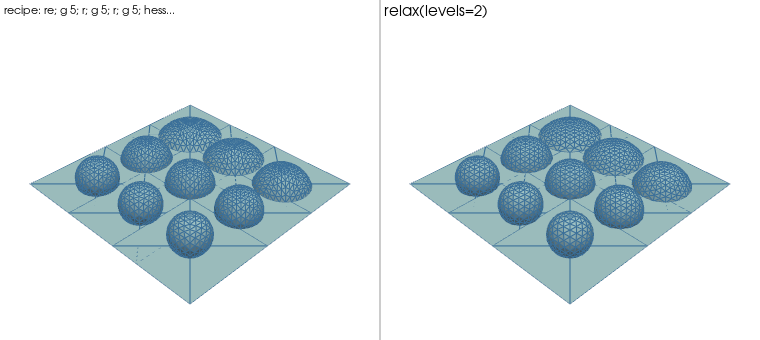
addload_example.fe: nine drops at once
On loading, the file’s setup script loads the mound eight more times next to the
first (addload), each drop with its own contact angle on its edges (from 50 to 130
degrees).
runs = bh.compare("addload_example.fe")
bh.show(runs)
| energy | residual | facets | seconds | converged | stable | notes | |
|---|---|---|---|---|---|---|---|
| recipe: re; g 5; r; g 5; r; g 5; hessian; hessian; | 32.97659991 | 3.8e-04 | 3492 | 0.03 | |||
| relax(levels=2) | 32.97519668 | 2.7e-09 | 2916 | 0.25 | yes | yes |
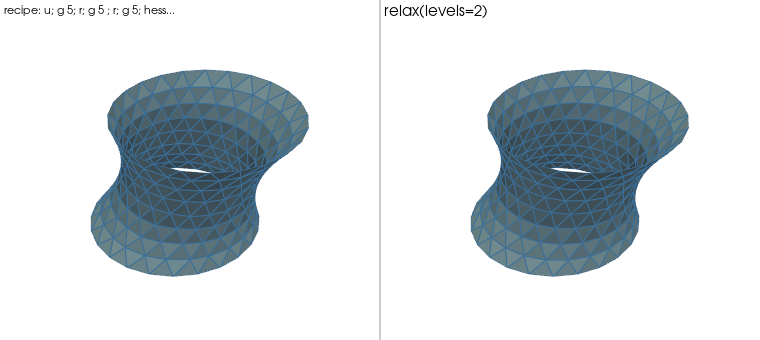
column.fe: a column of solder
A liquid solder column between two pads, its upper pad offset sideways (a skewed catenoid shape with a volume and gravity; units cgs). The file goes on to compute the forces on the pads by central differences.
runs = bh.compare("column.fe")
bh.show(runs)
| energy | residual | facets | seconds | converged | stable | notes | |
|---|---|---|---|---|---|---|---|
| recipe: u; g 5; r; g 5 ; r; g 5; hessian; hessian; do_yforce; do_zforce; | 10.48884222 | 2.0e-05 | 384 | 0.01 | |||
| relax(levels=2) | 10.48871534 | 4.7e-11 | 384 | 0.08 | yes | yes |
sphere.fe: liquid in a spherical tank
A spherical tank partly filled, with a contact angle on the wall. Straight edges can’t
follow the curved wall, so the file gives the gaps between them and the wall an
energy and volume (a “convex” constraint). Evolver has no Hessian for that gap energy,
so relax() uses gradient steps only; the recipe uses conjugate gradients at the
end.
print(bh.recipe("sphere.fe"))
runs = bh.compare("sphere.fe")
bh.show(runs)
g 5; r; g 5; r; g 5; r; g 10; conj_grad; g 20;
| energy | residual | facets | seconds | converged | stable | notes | |
|---|---|---|---|---|---|---|---|
| recipe: g 5; r; g 5; r; g 5; r; g 10; conj_grad; g 20; | 2.601739422 | 3.2e-02 | 512 | 0.04 | |||
| relax(levels=3) | 2.601058433 | 1.8e-02 | 512 | 8.68 | no |
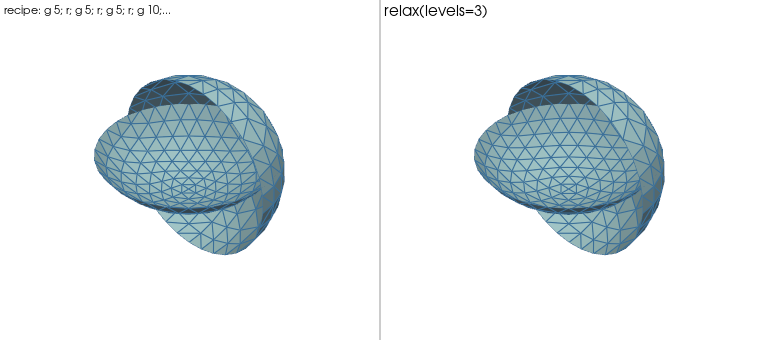
Neither run reaches a residual near zero: gradient steps converge slowly, and the energies agree to about 3e-4.
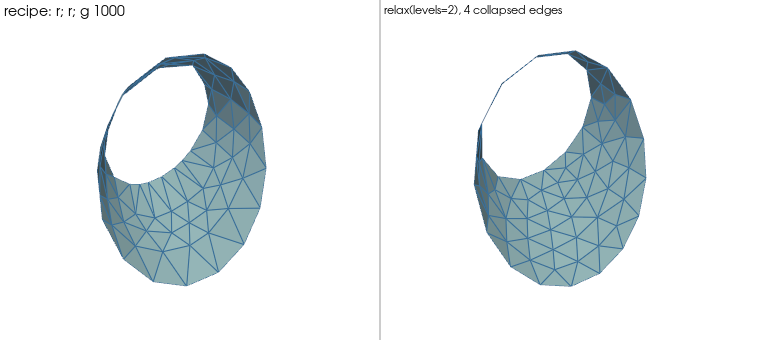
tankex.fe: liquid in a cylindrical tank
A flat-ended cylindrical tank on its side, gravity pulling the liquid to the wall, gap
energies as in sphere.fe. The file has no recipe; here two refinements and plain
gradient steps (it starts with 8 facets, too coarse to keep its shape on its own).
With no Hessian, relax() goes on with gradient rounds while no facet is degenerate;
from fewer refinements (levels=1) its facets degenerate first, and it stops there and
says so instead of sliding into what the degenerate mesh allows.
runs = bh.compare("tankex.fe", "r; r; g 1000", levels=2)
bh.show(runs)
| energy | residual | facets | seconds | converged | stable | notes | |
|---|---|---|---|---|---|---|---|
| recipe: r; r; g 1000 | 1.532271863 | 9.4e-01 | 128 | 6.47 | degenerate facets (smallest angle 8.5e-07 degrees, 4 below 5) | ||
| relax(levels=2), 4 collapsed edges | 1.505022704 | 6.8e-01 | 122 | 7.50 | no |
Solder joints: bga-1.fe, cbga1.fe, cbga2.fe
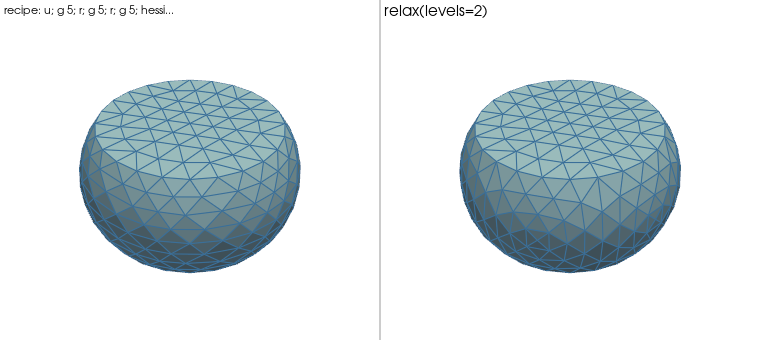
Three files from Brakke’s online examples (included with pySE), in cgs units
(surface tension 430-480 erg/cm²). bga-1.fe is the first of his ball grid array
tutorial: solder between two round pads.
runs = bh.compare("bga-1.fe")
bh.show(runs)
| energy | residual | facets | seconds | converged | stable | notes | |
|---|---|---|---|---|---|---|---|
| recipe: u; g 5; r; g 5; r; g 5; hessian; hessian | 0.1547576148 | 1.9e-07 | 576 | 0.00 | |||
| relax(levels=2) | 0.1547567657 | 3.0e-09 | 576 | 0.03 | yes | yes |
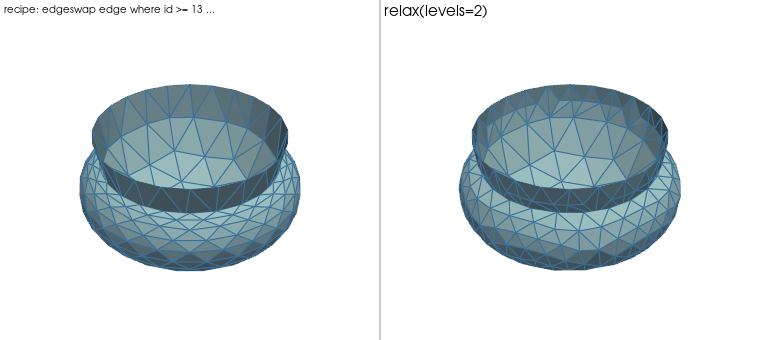
cbga1.fe holds solder between a pad and a sphere, its contact with the sphere as
edge integrals. It starts as a hexagonal prism of quads that Evolver splits at their
centres; the recipe first swaps the six vertical edges by hand (edgeswap), and
without that, gradient steps settle at an energy of 11 on the badly triangulated prism.
relax() equiangulates after its first step, which swaps them. (The recipe ends
unconverged.)
runs = bh.compare("cbga1.fe")
bh.show(runs)
| energy | residual | facets | seconds | converged | stable | notes | |
|---|---|---|---|---|---|---|---|
| recipe: edgeswap edge where id >= 13 and id <= 18; g 5; r; g 5; V; g 5; V; g 5; r; g 22; fixred; | 4.082864882 | 3.9e+01 | 504 | 0.02 | |||
| relax(levels=2) | 4.095419262 | 2.3e-11 | 576 | 0.26 | yes | no | unstable: 2 direction(s) lower the energy |
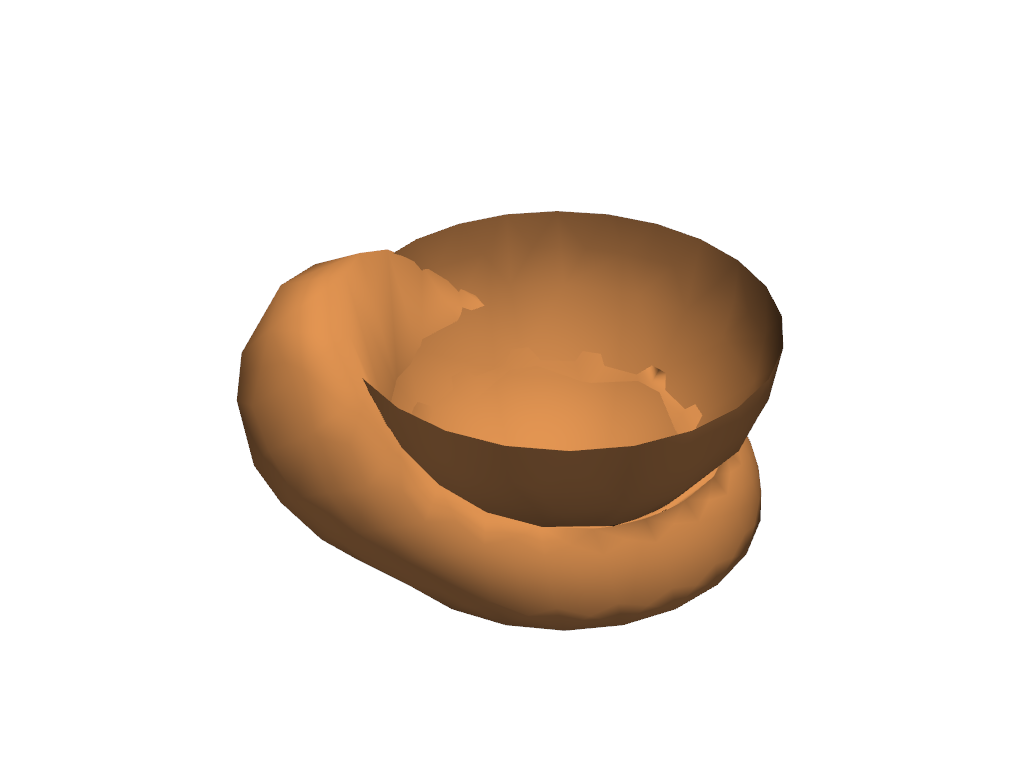
cbga2.fe is the same joint with explicit contact facets on the sphere. Its comments
say that at high contact angles the symmetric bulge is unstable, bulging to one side,
and suggest Evolver’s saddle to move off it. relax() finds the symmetric bulge and
reports it unstable; ev.saddle() steps along the unstable mode, and relaxing from
there finds the drop leaning over, at a lower energy.
import warnings
ev = pyse.Evolver("cbga2.fe")
with warnings.catch_warnings():
    warnings.simplefilter("ignore", pyse.UnstableEquilibriumWarning)
    r = ev.relax(levels=2)
print(f"symmetric: energy {ev.total_energy:.6f}, {r.negative_modes} unstable directions")
print(f"saddle() lowers the energy by {ev.saddle():.4f}")
r = ev.relax()
print(f"leaning:   energy {ev.total_energy:.6f}, stable: {r.stable}")
ev.plot(color="sandybrown", show_edges=False, smooth_shading=True)
symmetric: energy 3.943787, 2 unstable directions
saddle() lowers the energy by 0.0361
leaning: energy 3.835180, stable: True
Next
Energies other than surface tension: Brakke’s samples: crystals and elastic
membranes. The same physics built from arrays, with
pyse.constraints writing the contact-angle integrals: the
liquid bridge and the slit droplet.
Brakke’s ball grid array series in full: solder joints.