Solder joints: force, standoff and alignment
A ball grid array (BGA) joins a chip to a board with an array of solder joints: liquid
solder wetting a round pad on each side. While the solder is molten, surface tension
and gravity alone hold the chip, so the questions are mechanical: what force does a
joint exert on its pad, how high does a chip of a given weight float, and does a
misplaced chip pull itself back into line? Ken Brakke’s
BGA tutorial answers them with a series
of datafiles, bga-1.fe to bga-10.fe and bga-30.fe, shipped with pySE
(pyse.examples) together with his command files (zforce.cmd, …). Units are
cgs: lengths in cm, the solder’s surface tension 480 erg/cm², forces in dynes.
This notebook follows the series with relax(), derivative() (forces),
optimizing parameters (ev.parameters.optimize) and recipes.continuation. It loads
Brakke’s datafiles as they are, where the liquid bridge builds
its surface from arrays; it assumes Getting started and
Relaxing a surface.
import warnings
import numpy as np
import matplotlib.pyplot as plt
import pyvista as pv
import pysurfaceevolver as pyse
from pysurfaceevolver import recipes

pv.set_jupyter_backend("static")
The joint
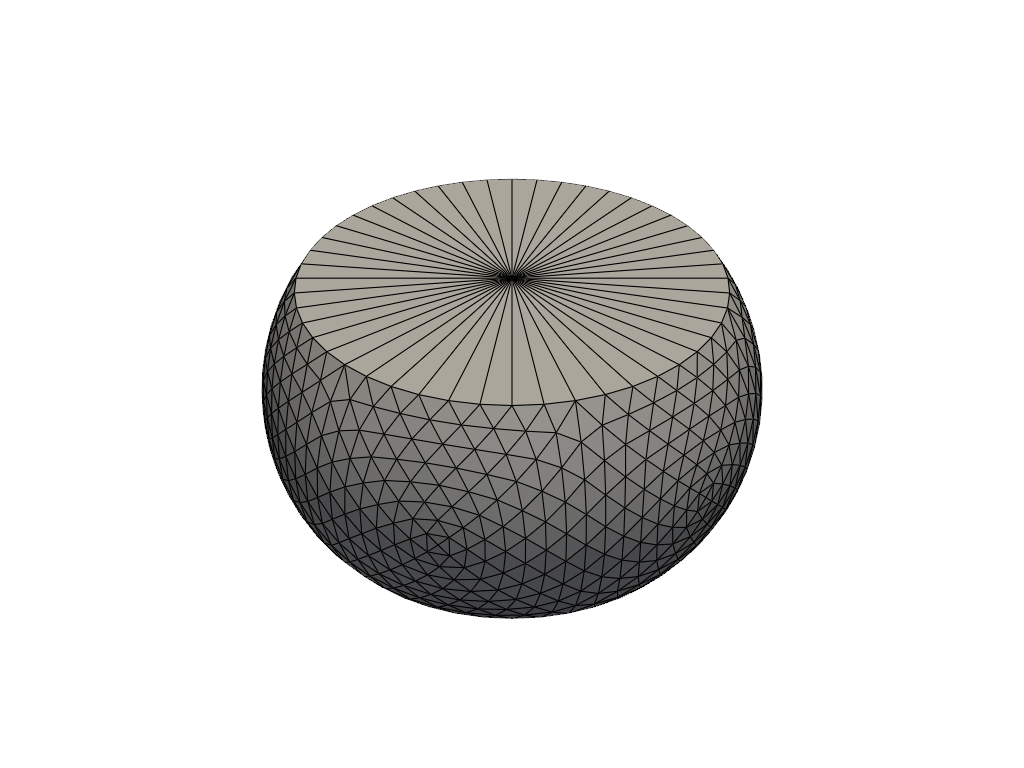
bga-3.fe: two coaxial pads of radius 0.1 cm, 0.12 cm apart, the solder’s volume 1.3
times the cylinder between them, with gravity. The pads are constraints (z = 0 and
z = height, height a parameter) and their rims are fixed vertices. Brakke’s
datafiles start from very few facets; relax(levels=3) refines three times.
ev = pyse.Evolver("bga-3.fe")
result = ev.relax(levels=3)
print(result)
print(f"{ev.counts['facets']} facets, energy {ev.total_energy:.6f} erg, "
      f"pressure {ev.body(1).pressure:.1f} dyn/cm^2")
ev.plot(off_screen=True, color="silver")
IterationResult(converged after 210 gradient steps and 3 Newton, residual 7.2e-11, stable, health ok)
1632 facets, energy 46.807403 erg, pressure 9418.0 dyn/cm^2
The force on the upper pad
The vertical force the joint exerts on the upper pad is minus the derivative of the
equilibrium energy with respect to the pad’s height. Brakke’s tutorial (bga-4) compares
seven ways to get it; the reliable ones move the whole joint with the pad (each vertex
by z/height times the change) and correct for the volume change by the pressure, or
re-converge after the move. ev.derivative does both:
method="fixed"withmove=: Brakke’s preferredzforce4, no relaxing;the default
method="newton": Newton steps re-converge the moved surface (zforce5).
bga-4.fe is the same joint with Brakke’s variational integral for the force (the
quantity zforce7), and his command file computes zforce4. All three agree:
def linear(ev):
    h = ev.parameters["height"]
    return lambda x: np.c_[0*x[:, :2], x[:, 2]/h]          # stretch with the pad

ev = pyse.Evolver("bga-4.fe")
ev.command('read "zforce.cmd"')
print(f"{'facets':>7} {'fixed':>12} {'newton':>12} {'variational':>12} {'zforce4':>12}")
ev.relax(levels=2)
for level in range(2, 6):
    if level > 2:
        ev.relax(levels=1)
    fixed = -ev.derivative("height", method="fixed", move=linear(ev))
    newton = -ev.derivative("height", move=linear(ev))
    variational = ev.quantity("zforce7").value
    zforce4 = float(ev.command("zforce4").split()[1])
    print(f"{ev.counts['facets']:7d} {fixed:12.6f} {newton:12.6f} {variational:12.6f} "
          f"{zforce4:12.6f}")
facets fixed newton variational zforce4
432 29.970505 29.970561 29.970505 29.970505
1632 19.874275 19.874293 19.874275 19.874275
6336 17.488354 17.488362 17.488354 17.488354
24960 16.899279 16.899284 16.899278 16.899278
The methods agree to the printed digits at each refinement, but the force itself moves
from about 30 to 17 dynes as the mesh is refined: on Brakke’s starting meshes it is far
from converged. Without move, derivative() would move only the pad’s own row of
vertices (its rim is fixed, so the rest of the mesh doesn’t follow), which differs at
first order in the edge length; give move whenever vertices are fixed to a moving
wall.
The axisymmetric version of the same joint, bga-30.fe (a string model of the
meridian, Brakke’s named quantities for area, volume and gravity), converges much faster
and gives the reference the 3D joint approaches. Its pads are the lines y = 0 and
y = height, so the linear move is in y. Its start has every vertex on a pad (nothing
free to move): relax(levels=...) refines before relaxing.
axi = pyse.Evolver("bga-30.fe")
axi.relax(levels=2)
for level in range(2, 8):
    if level > 2:
        axi.relax(levels=1)
    h = axi.parameters["height"]
    force = -axi.derivative("height", method="fixed", move=lambda x: np.c_[0*x[:, :1], x[:, 1]/h])
    print(f"{axi.counts['edges']:4d} edges  force {force:.6f} dyn")
   7 edges  force 33.765702 dyn
  11 edges  force 20.879410 dyn
  19 edges  force 17.911707 dyn
  35 edges  force 17.184286 dyn
  67 edges  force 17.003318 dyn
 131 edges  force 16.958131 dyn
Force against height
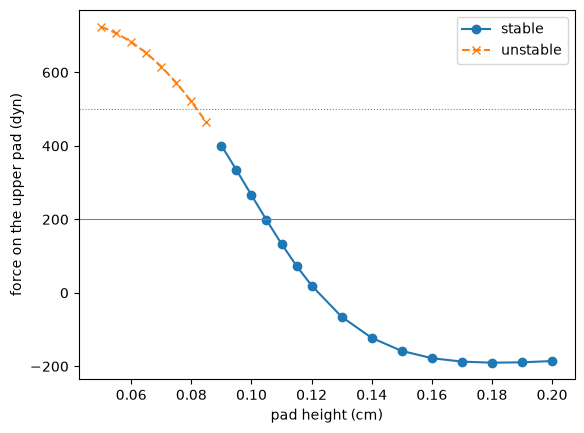
Squeezing the joint (a lower height) pushes the pads apart harder; pulling it up
turns the force into a pull. recipes.continuation steps the height, relaxing after
each step; the force comes from derivative and the stability from the relax result.
Below a height of about 0.09 cm the joint becomes unstable: it would rather bulge to one
side (compare Brakke’s cbga2.fe in Brakke’s samples: capillarity).
def force(ev):
    return -ev.derivative("height", method="fixed", move=linear(ev))

rows = []
with warnings.catch_warnings():     # unstable joints are expected here: plotted as such
    warnings.simplefilter("ignore", pyse.UnstableEquilibriumWarning)
    for direction in (np.linspace(0.12, 0.05, 15), np.linspace(0.12, 0.20, 9)[1:]):
        ev = pyse.Evolver("bga-3.fe")
        ev.relax(levels=3)
        for step in recipes.continuation(ev, "height", direction):
            rows.append((step.value, force(ev), step.result.stable))
rows.sort()
h, F, stable = (np.array(c) for c in zip(*rows))
plt.plot(h[stable], F[stable], "o-", label="stable")
plt.plot(h[~stable], F[~stable], "x--", label="unstable")
plt.axhline(200, color="gray", lw=0.8)
plt.axhline(500, color="gray", lw=0.8, ls=":")
plt.xlabel("pad height (cm)")
plt.ylabel("force on the upper pad (dyn)")
plt.legend()
plt.show()
load_height = np.interp(200, F[::-1], h[::-1])
print(f"a load of 200 dyn is carried at height {load_height:.4f} cm")
a load of 200 dyn is carried at height 0.1049 cm
How high a loaded chip floats
bga-5.fe puts a load of 200 dynes on the upper pad (an energy pad_weight*z on a
vertex riding on it) and makes height an optimizing parameter: the minimization
moves it along with the vertices, so relax() finds the height where the joint’s push
balances the load. The residual counts the force on each optimizing parameter, so
relax() doesn’t stop until it is balanced; at the end the derivative with the load
included is close to zero (it vanishes as the mesh is refined, the move above and
Evolver’s own finite difference being different discretizations).
Evolver differentiates the energy with respect to an optimizing parameter by finite
differences (with bga-5.fe’s step pdelta = 1e-5), also for the Newton steps’
second derivatives; relax() converges with its default tolerance all the same.
ev = pyse.Evolver("bga-5.fe")
print("optimizing:", sorted(ev.parameters.optimizing))
result = ev.relax(levels=3)
print(result)
print(f"height {ev.parameters['height']:.4f} cm (from the curve: {load_height:.4f}), "
      f"dE/dheight {ev.derivative('height', method='fixed', move=linear(ev)):.3g} dyn")
optimizing: ['height']
IterationResult(converged after 261 gradient steps and 4 Newton, residual 2.8e-10, stable, health ok)
height 0.1049 cm (from the curve: 0.1049), dE/dheight 0.565 dyn
/tmp/ipykernel_5158/3439717664.py:3: EvolverWarning: WARNING 1055: Volume or quantity constraints don't converge in 10 projections.
Total difference 27475.6 times tolerance (and 2 more like it during relax())
  result = ev.relax(levels=3)
ev.parameters.optimize(name, False) fixes an optimizing parameter at its value (and
optimize(name) frees any parameter): here the joint without the load’s freedom, a
fixed gap again.
bga-6.fe loads the pad with 500 dynes. The curve says why that ends badly: the joint
carries 500 dynes only in its unstable range, so the chip crushes the joint sideways.
relax() reports it, and so does Brakke’s own recipe (the height runs off below zero):
ev = pyse.Evolver("bga-6.fe")
result = ev.relax(levels=2)
print(result.converged, f"height {ev.parameters['height']:.3f}")
print(result.health.summary())
False height -0.907
not in equilibrium (residual 1.2e+03); degenerate facets (smallest angle 0.55 degrees, 66 below 5); the surface nearly touches itself (0.079 edge lengths); a fixed volume or quantity is off its target (0.0013 relative)
/tmp/ipykernel_5158/782485175.py:2: EvolverWarning: WARNING 1792: Vertex 14 doesn't converge to constraint 5 after 10 iterations.
 maxdiff = 0.517222, constraint_tolerance 1e-12 (and 83637 more like it during relax())
  result = ev.relax(levels=2)
/tmp/ipykernel_5158/782485175.py:2: EvolverWarning: WARNING 1055: Volume or quantity constraints don't converge in 10 projections.
Total difference 2972.93 times tolerance (and 2 more like it during relax())
  result = ev.relax(levels=2)
A chip that pulls itself into line
bga-7.fe offsets the upper pad sideways (the parameter offset). The joint pulls it
back: the sideways force, from derivative with the upper part of the joint sheared
along (each vertex by z/height in x), grows linearly with the offset, a spring of
about 1100 dyn/cm.
ev = pyse.Evolver("bga-7.fe")
ev.relax(levels=3)
shear = lambda x: np.c_[x[:, 2]/ev.parameters["height"], 0*x[:, 1:]]
for step in recipes.continuation(ev, "offset", [0.0, 0.01, 0.02, 0.04, 0.06, 0.08]):
    fx = -ev.derivative("offset", method="fixed", move=shear)
    print(f"offset {step.value:.3f} cm  sideways force {fx:8.3f} dyn  "
          f"energy {step.energy:.5f}")
offset 0.000 cm sideways force 0.005 dyn energy 46.80768
offset 0.010 cm  sideways force  -11.079 dyn  energy 46.86329
offset 0.020 cm  sideways force  -21.966 dyn  energy 47.03005
offset 0.040 cm sideways force -42.421 dyn energy 47.68084
offset 0.060 cm sideways force -60.352 dyn energy 48.71944
offset 0.080 cm sideways force -75.220 dyn energy 50.08605
bga-9.fe frees both the offset and the height, with the load on: started 0.03 cm off,
the chip slides back to the centre and settles at the loaded height.
ev = pyse.Evolver("bga-9.fe")
print({k: ev.parameters[k] for k in sorted(ev.parameters.optimizing)})
result = ev.relax(levels=3)
print(result)
print({k: round(ev.parameters[k], 6) for k in sorted(ev.parameters.optimizing)})
{'height': 0.12, 'offset': 0.03}
IterationResult(converged after 242 gradient steps and 4 Newton, residual 3.8e-09, stable, health ok)
{'height': 0.104793, 'offset': 6e-06}
bga-10.fe tilts the upper pad as well (a fixed tilt and 2D offset); the same tools
apply. Brakke’s bga-11.fe and bga-12.fe free the tilt too, and bga-31.fe adds
contact angles to the axisymmetric model; in Evolver 2.70 they run away even with his
own recipes, so they are not included.
Next
The slit droplet builds a liquid against several walls and mirror
planes from arrays, and closes it face by face for a volume mesh. More of Brakke’s
solder files (column.fe, cbga1.fe, cbga2.fe) are in
Brakke’s samples: drops and capillarity.