Stress cases
Fourteen hard problems with exact, axisymmetric or finer-mesh references, thirteen run
with relax()’s defaults alone and one with explicit remeshing: contact lines that
travel far, surfaces that grow or shrink a hundredfold, wires, instabilities, gravity. They are the stress suite in
bench/stress/ condensed into examples (python bench/stress/run.py runs the full
versions and checks them). The code below is not run when the documentation is built;
the outputs are from running it in October 2026 (pySE 0.7.3 and 0.7.4, 2 threads),
and they vary in the last digits with the thread count.
The starting shapes come from pysurfaceevolver.shapes, the reference solutions from
docs/stress_helpers.py
(they need SciPy; the drainage band’s come from
docs/drainage_helpers.py); run the examples from the docs directory, or put it on
sys.path. recipes.continuation steps a parameter or a volume and relaxes after
each step; step.result is that relaxation’s result.
Each case has two figures, from a run of the full suite version
(python bench/stress/figures.py, which also redraws them): the result against its
reference, the error per step with the case’s pass limit, and what relax() did at each
step (gradient and Newton steps, seconds, and marks where it didn’t converge or reported
an unstable equilibrium); and the surface at a few steps.
The drainage band is the exception: on defaults alone it fails, so it is run the way its notebook runs it, remeshed before each step; its section says why.
A liquid column past Rayleigh-Plateau
A column of liquid between two plates (contact angle 90 degrees, so the contact lines slide freely), thinned at constant height. A cylinder is an equilibrium at every radius, but once its height exceeds its circumference (radius below 1/pi for height 1) it is a saddle: any waist lowers the area. The solver keeps finding the cylinder; only the stability check tells.
import numpy as np
import pysurfaceevolver as pyse
from pysurfaceevolver import constraints as C, recipes, shapes

# a liquid column of radius 0.5 between the plates z = 0 and z = 1, contact angle 90
column = shapes.tube(0.5, 0.0, 1.0, nz=12, nt=24)
ev = pyse.Evolver()
ev.load_arrays(column.vertices, column.faces,
               constraints={1: C.plane((0, 0, 1), 0.0), 2: C.plane((0, 0, -1), point=(0, 0, 1))},
               vertex_constraints={1: column.rims["bottom"], 2: column.rims["top"]},
               bodies=[pyse.Body(volume=np.pi*0.5**2)])
ev.relax()

# thin it at constant height: past r = 1/pi the column is a saddle (Rayleigh-Plateau)
for step in recipes.continuation(ev, ev.body(1), np.pi*np.linspace(0.5, 0.2, 25)**2):
    if step.result.stable is False:
        print(f"unstable from r = {np.sqrt(step.value/np.pi):.4f} (theory 1/pi = {1/np.pi:.4f})")
        break
unstable from r = 0.3125 (theory 1/pi = 0.3183)
The check flags it one step past the onset (the steps are 0.0125 apart in radius).
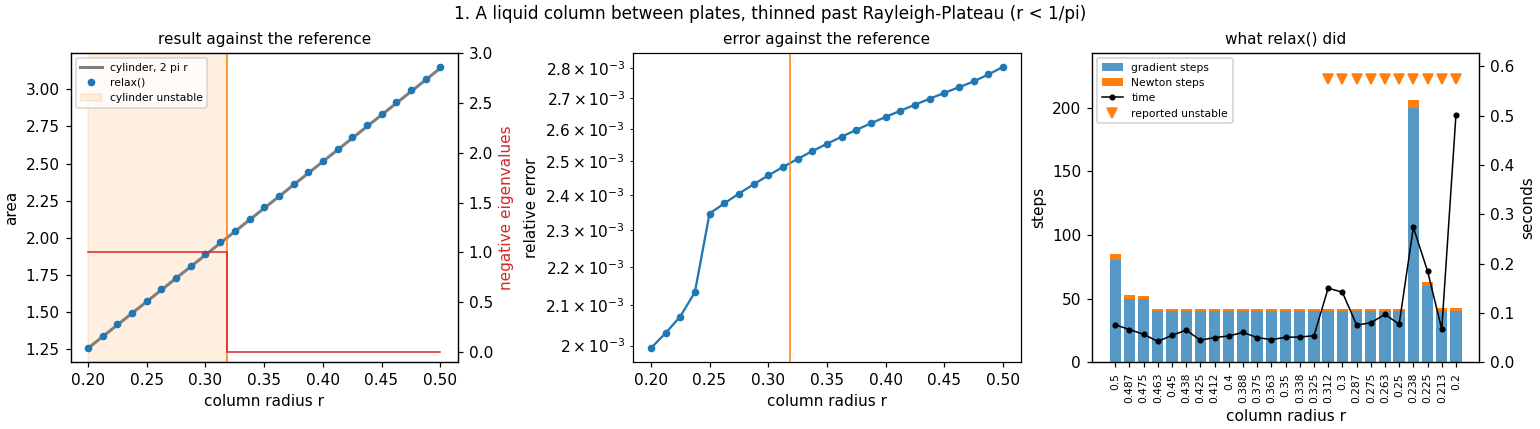
Left, the column’s area against the cylinder’s, with the count of negative Hessian eigenvalues (red) turning to one at r = 1/pi; relax() marks every step past the onset unstable. Middle, the error against the reference. Right, what relax() did at each step.
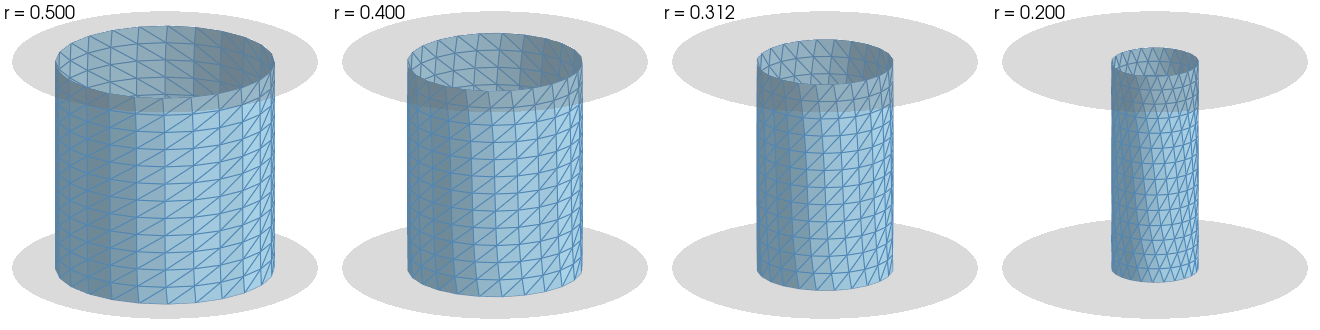
The column at radius 0.5, 0.4, at the onset and at 0.2: still a cylinder, a saddle.
A catenoid to its fold
A soap film between two wire rings of radius 1, pulled apart. Up to H = 0.6627 the stable catenoid exists; past the fold its neck collapses and the film pinches off into two flat discs, one in each ring. The wires are curves where two constraints meet: their vertices can only slide along them, which Newton must not mistake for a freedom.
import numpy as np
import pysurfaceevolver as pyse
from pysurfaceevolver import recipes, shapes

def catenoid_area(H):
    """The stable catenoid between rings of radius 1 at z = +-H (None past the fold)."""
    lo, hi = 1/np.cosh(1.19967864), 1.0
    if H >= 1.19967864/np.cosh(1.19967864):
        return None
    for _ in range(100):
        a = (lo + hi)/2
        lo, hi = (lo, a) if a*np.cosh(H/a) > 1 else (a, hi)
    return np.pi*a*(2*H + a*np.sinh(2*H/a))

# a soap film between two wire rings, the rings pulled apart (parameter hh)
film = shapes.tube(1.0, -0.3, 0.3, nz=8, nt=32)
bottom, top = film.rims["bottom"], film.rims["top"]
ev = pyse.Evolver()
ev.load_arrays(film.vertices, film.faces,
               constraints={1: "x^2 + y^2 = 1", 2: "z = hh", 3: "z = -hh"},
               vertex_constraints={1: bottom + top, 2: top, 3: bottom}, parameters={"hh": 0.3})
ev.relax(levels=1)
for step in recipes.continuation(ev, "hh", np.arange(0.325, 0.76, 0.025)):
    ref = catenoid_area(step.value)
    if ref is not None:
        print(f"H = {step.value:.3f}: area {ev.total_energy:.6f}, catenoid {ref:.6f}, "
              f"error {abs(ev.total_energy/ref - 1):.2%}")
    else:
        print(f"H = {step.value:.3f}: past the fold, area {ev.total_energy:.6f} (two discs "
              f"{2*np.pi:.6f}), converged {step.result.converged}")
H = 0.325: area 4.008181, catenoid 4.009254, error 0.03%
H = 0.350: area 4.303094, catenoid 4.304133, error 0.02%
H = 0.375: area 4.594750, catenoid 4.595759, error 0.02%
H = 0.400: area 4.882871, catenoid 4.883793, error 0.02%
H = 0.425: area 5.166914, catenoid 5.167861, error 0.02%
H = 0.450: area 5.446549, catenoid 5.447546, error 0.02%
H = 0.475: area 5.721403, catenoid 5.722374, error 0.02%
H = 0.500: area 5.990525, catenoid 5.991797, error 0.02%
H = 0.525: area 6.253760, catenoid 6.255163, error 0.02%
H = 0.550: area 6.510162, catenoid 6.511674, error 0.02%
H = 0.575: area 6.758706, catenoid 6.760303, error 0.02%
H = 0.600: area 6.997992, catenoid 6.999643, error 0.02%
H = 0.625: area 7.225880, catenoid 7.227532, error 0.02%
H = 0.650: area 7.438262, catenoid 7.439781, error 0.02%
H = 0.675: past the fold, area 6.273097 (two discs 6.283185), converged True
H = 0.700: past the fold, area 6.273097 (two discs 6.283185), converged True
H = 0.725: past the fold, area 6.273097 (two discs 6.283185), converged True
H = 0.750: past the fold, area 6.273097 (two discs 6.283185), converged True
Within 0.03% of the exact catenoid up to the fold. Past it, relax() can’t converge
the film, lets the neck collapse, deletes its collapsed ring of edges and pops the
pinched vertex (step.result.collapsed, .popped): two discs, whose area is that of
the 64-sided polygons the rings’ vertices make (0.16% below 2 pi).
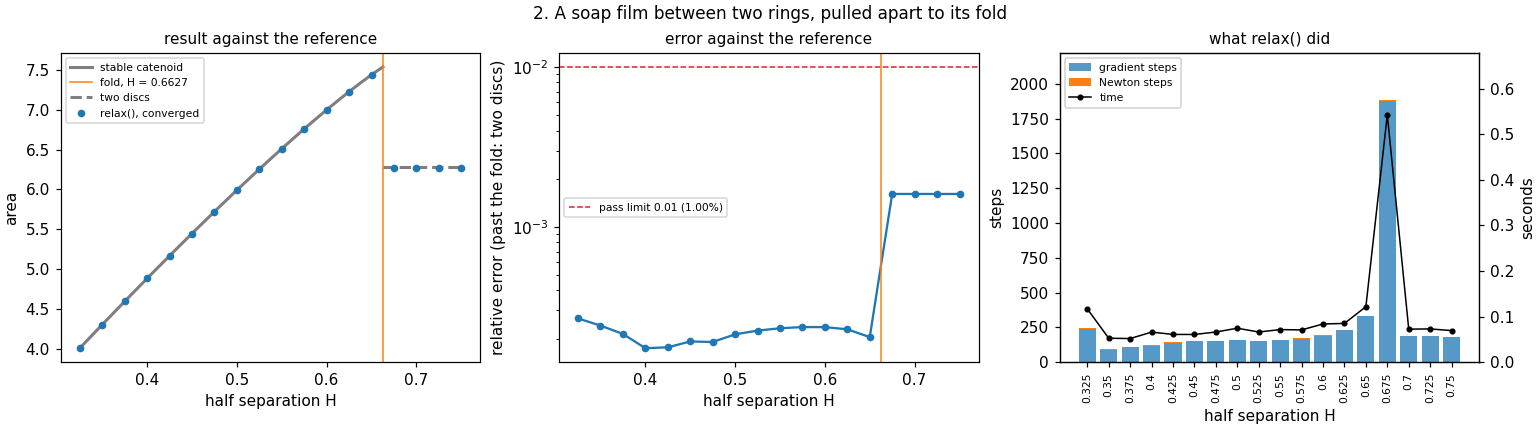
Left, the film’s area on the exact catenoid up to the fold, and past it on two flat discs. Middle, the error against the reference. Right, what relax() did at each step.
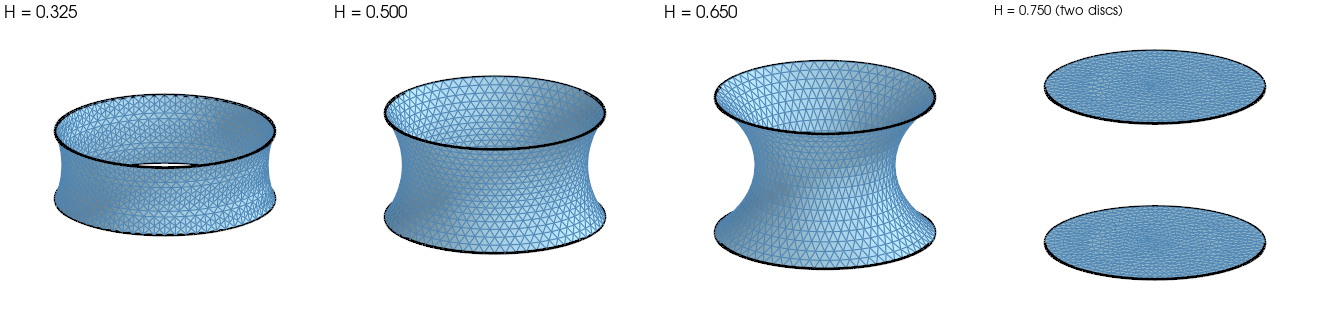
The film at H = 0.325, 0.5 and 0.65, and past the fold, pinched off into two discs.
A sessile drop at high contact angles
A drop (no gravity) whose contact angle is stepped from 90 to 170 degrees at fixed
volume: the drop rolls up into nearly a sphere on a small contact disk. Reference: the
exact spherical cap. The contact circle shrinks below the size of the facets next to
it; after converging, relax() splits the long edges leaving the contact line and
relaxes again, while some are long (the facet count grows near the rim).
import numpy as np
import pysurfaceevolver as pyse
from pysurfaceevolver import constraints as C, recipes, shapes
from stress_helpers import cap_reference, contact_radius

# a hemispherical drop on the plane z = 0, its contact angle the parameter theta
drop = shapes.cap(1.0, 1.0)
ev = pyse.Evolver()
ev.load_arrays(drop.vertices, drop.faces,
               constraints={1: C.plane((0, 0, 1), 0.0, contact_angle="theta")},
               vertex_constraints={1: drop.rims["rim"]}, parameters={"theta": 90.0},
               bodies=[pyse.Body(volume=2*np.pi/3)])
ev.relax()
for step in recipes.continuation(ev, "theta", np.arange(100.0, 175, 10)):
    ref = cap_reference(2*np.pi/3, step.value)
    print(f"theta {step.value:5.1f}: energy error {abs(ev.total_energy/ref['energy'] - 1):.2%}, "
          f"contact radius {contact_radius(ev, 1):.4f} (exact {ref['radius']:.4f}), "
          f"{ev.counts['facets']} facets")
theta 100.0: energy error 0.19%, contact radius 0.9179 (exact 0.9123), 480 facets
theta 110.0: energy error 0.21%, contact radius 0.8286 (exact 0.8222), 480 facets
theta 120.0: energy error 0.24%, contact radius 0.7352 (exact 0.7274), 480 facets
theta 130.0: energy error 0.25%, contact radius 0.6349 (exact 0.6261), 608 facets
theta 140.0: energy error 0.22%, contact radius 0.5258 (exact 0.5168), 736 facets
theta 150.0: energy error 0.20%, contact radius 0.4086 (exact 0.3986), 864 facets
theta 160.0: energy error 0.18%, contact radius 0.2837 (exact 0.2717), 992 facets
theta 170.0: energy error 0.17%, contact radius 0.1551 (exact 0.1378), 1376 facets
Energies within 0.25%. At 170 degrees the contact disk (radius 0.14) is small next to
the facets around it: relax() splits the long edges leaving the contact line, up to
three times per call while some are long, and the implied contact angle is 1.3
degrees off (the radius 12% off). A finer start does better: one refinement more
brings it within 0.3 degrees.
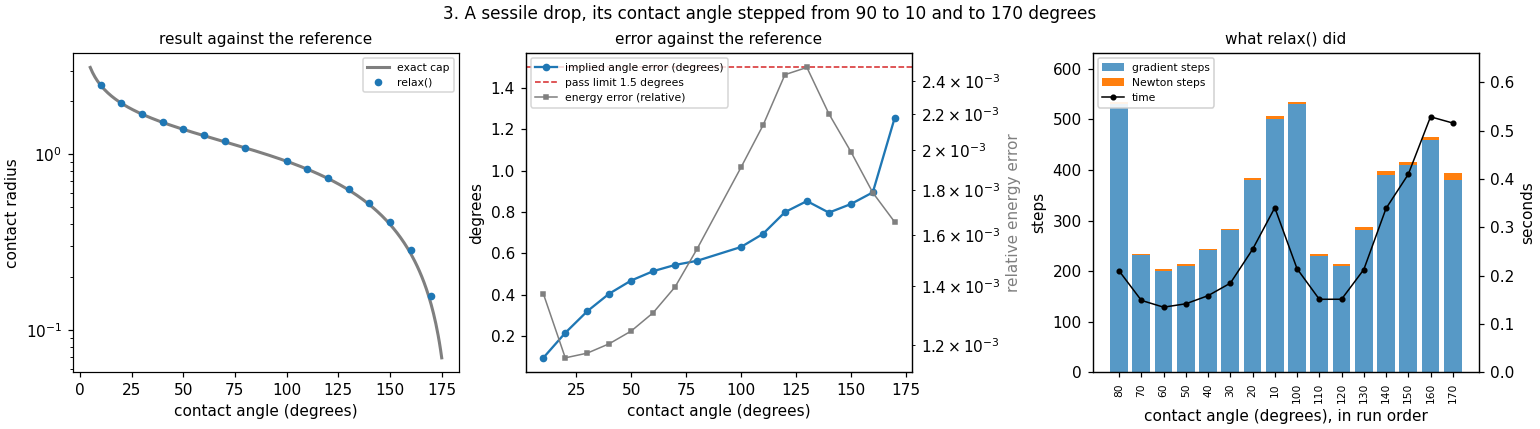
Left, the contact radius against the exact cap (log scale) and the error of the implied contact angle (limit 1.5 degrees) and of the energy; the first bar of each sweep includes the first relaxation. Middle, the error against the reference. Right, what relax() did at each step.
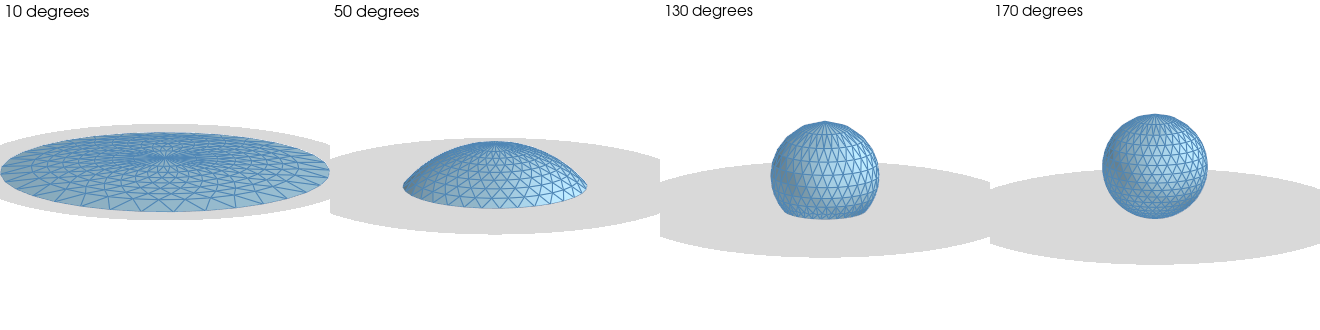
The drop at 10, 50, 130 and 170 degrees, same volume.
A liquid bridge as the gap closes
A bridge of liquid (volume 0.05, contact angle 40) between two unit spheres, the gap
closed from 0.2 to 1e-3. Each gap starts from a coarse cylinder (16 around, radius
0.35: relaxing meets the volume) and is relaxed with levels=2. Reference: the axisymmetric Young-Laplace solution. On that
coarse start the contact lines can collapse within a few steps; relax() notices and
undoes it.
import numpy as np
import pysurfaceevolver as pyse
from pysurfaceevolver import constraints as C, shapes
from stress_helpers import bridge_spheres

def bridge(gap, theta=40.0, volume=0.05, a=0.35):
    """A liquid bridge between unit spheres, from a cylinder of radius a."""
    c = 1 + gap/2
    zb = c - np.sqrt(1 - a*a)                  # the cylinder's ends on the spheres
    tube = shapes.tube(a, -zb, zb, nz=4, nt=16)
    ev = pyse.Evolver()
    ev.load_arrays(tube.vertices, tube.faces,
                   constraints={1: C.sphere((0, 0, -c), 1.0, contact_angle=theta, wet_poles=("north",)),
                                2: C.sphere((0, 0, c), 1.0, contact_angle=theta, wet_poles=("south",))},
                   vertex_constraints={1: tube.rims["bottom"], 2: tube.rims["top"]},
                   bodies=[pyse.Body(volume=volume)])    # volconst: the spheres' caps
    ev.relax(levels=2)
    return ev

for gap in (0.2, 0.05, 0.01, 0.001):
    ev = bridge(gap)
    ref = bridge_spheres(0.05, gap, 40.0)
    # ev.energy: with the wetted caps' energy, which Evolver's total_energy leaves out
    print(f"gap {gap:5.3f}: energy {ev.energy:.5f} (reference {ref['energy']:.5f}), "
          f"pressure {ev.body(1).pressure:.4f} (reference {ref['pressure']:.4f})")
gap 0.200: energy 0.08377 (reference 0.08390), pressure -0.1755 (reference -0.1734)
gap 0.050: energy -0.24965 (reference -0.24967), pressure -1.9178 (reference -1.9090)
gap 0.010: energy -0.37992 (reference -0.37985), pressure -1.8925 (reference -1.8867)
gap 0.001: energy -0.41160 (reference -0.41151), pressure -1.8433 (reference -1.8377)
Energies within 0.2% and pressures within 0.01 (0.5% where they are large) at every gap.
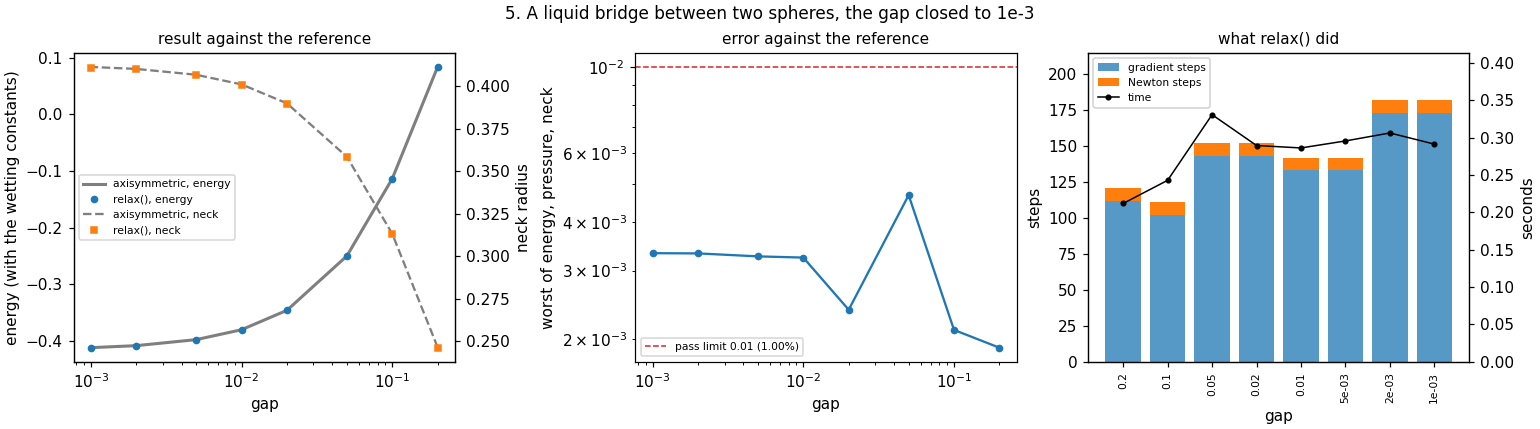
Left, energy and neck radius against the axisymmetric bridge, the gap on a log scale; each gap is a new surface relaxed with two refinements. Middle, the error against the reference. Right, what relax() did at each step.
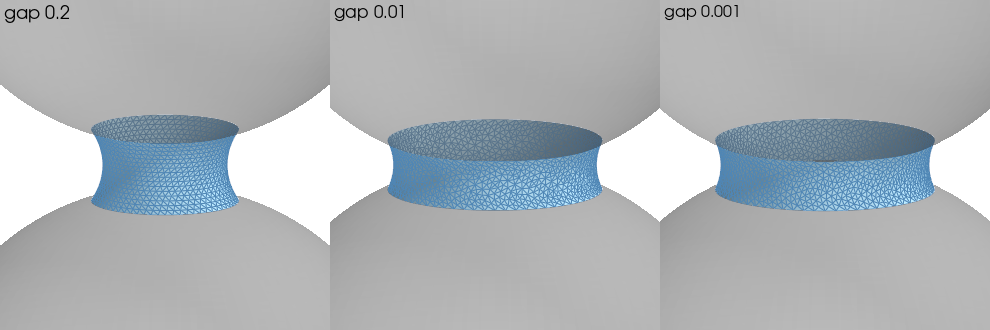
The bridge at gaps 0.2, 0.01 and 0.001.
A barrel drop on a fibre
A drop of volume 2 on a fibre of radius 0.2, its contact angle stepped from 20 to 80 degrees. Reference: the axisymmetric barrel. Small drops at higher contact angles roll up to one side (a clam shell); the symmetric barrel remains an equilibrium, a saddle, and the stability check reports it. Sliding along the fibre is an exact zero mode, which must not count as an instability.
import numpy as np
import pysurfaceevolver as pyse
from pysurfaceevolver import constraints as C, recipes, shapes
from stress_helpers import barrel

# a barrel drop (volume 2) on a fibre of radius 0.2 (the z axis)
z = np.linspace(-1.2, 1.2, 13)
drop = shapes.revolve(np.sqrt(0.04 + (0.75**2 - 0.04)*(1 - (z/1.2)**2)), z, nt=24)
ev = pyse.Evolver()
ev.load_arrays(drop.vertices, drop.faces,
               constraints={1: C.cylinder((0, 0, 0), (0, 0, 1), 0.2, contact_angle="theta")},
               vertex_constraints={1: drop.rims["bottom"] + drop.rims["top"]},
               parameters={"theta": 20.0}, bodies=[pyse.Body(volume=2.0)])
ev.relax(levels=1)
guess = (0.78, 2.4)
for step in recipes.continuation(ev, "theta", np.arange(20.0, 81, 10)):
    ref = barrel(2.0, 0.2, step.value, guess=guess)
    guess = (ref["equator"], ref["pressure"])
    print(f"theta {step.value:4.0f}: energy {ev.total_energy:.4f} (barrel {ref['energy']:.4f}), "
          f"stable {step.result.stable}")
theta   20: energy 5.8215 (barrel 5.8114), stable True
theta   30: energy 6.0292 (barrel 6.0202), stable True
theta   40: energy 6.2921 (barrel 6.2842), stable True
theta   50: energy 6.5938 (barrel 6.5870), stable True
theta   60: energy 6.9187 (barrel 6.9130), stable True
theta   70: energy 7.2530 (barrel 7.2483), stable False
theta   80: energy 7.5844 (barrel 7.5806), stable False
Within 0.2% of the barrel; unstable (two negative modes, the roll-up in two directions) from 70 degrees on.
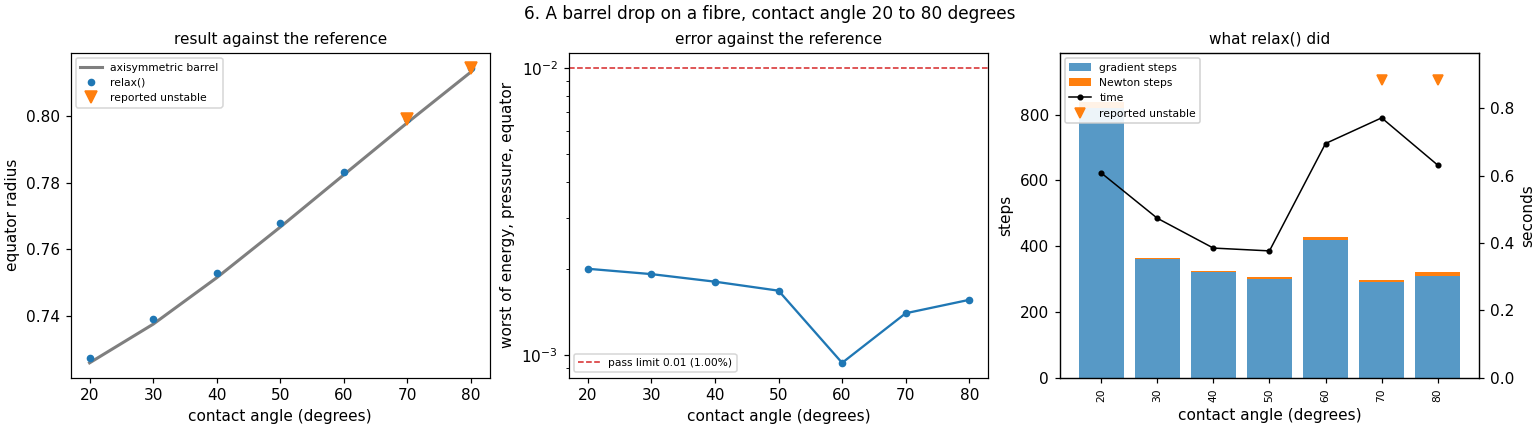
Left, the equator radius against the axisymmetric barrel; from 70 degrees relax() reports the barrel unstable (orange): it would roll up into a clam shell. Middle, the error against the reference. Right, what relax() did at each step.
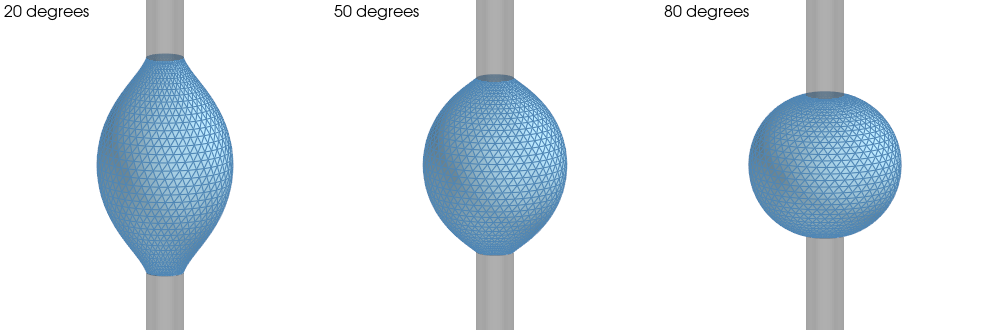
The barrel at 20, 50 and 80 degrees.
A drainage band, remeshed
The band of slit_drainage at bead spacing 1.1: beads in a slit
drained from immersed, past the moment the beads emerge, along the band that forms
between them, to its snap at the mid-plane. Reference: a run on a finer mesh (one more
refinement, steps of 1%) stored with the notebook. This is the one case not run on
relax()’s defaults alone: as the dry patch on the bead grows, its contact line runs
ahead of the free vertices behind it and squeezes them into slivers, so the band is
remeshed by edge length before each step, as in the notebook. Without that, nearly every
step ends unconverged and the worst pressure is off by 3% to over 50%, depending on the
run (Relaxing a surface has why that is not automatic).
import numpy as np
import drainage_helpers as dh

class Cell(dh.Cell):
    """The notebook's cell, recording whether each band step's relax() converges."""
    band = []

    def relax(self, ev, remesh=False):
        if remesh:      # a band step: remesh by edge length first (h: the first median edge)
            if self.edge_h is None:
                self.edge_h = ev.mesh_quality().edge_median
            ev.remesh(target=self.edge_h)
        result = ev.relax(stability=False)  # no stability check: the band is unstable near its snap
        if remesh:
            self.band.append(result.converged)

cell = Cell(1.1)
cell.band_step = 0.03
states, events = dh.drain(cell, cell.meniscus_exact(0.55)[0], 0.004, levels=2)
ref = np.load("_static/drainage_runs.npz")
on_band = ref["l1.1_stage"] == 1
v, p = ref["l1.1_volume"][on_band], ref["l1.1_pressure"][on_band]
order = np.argsort(v)
errors = [abs(s["pressure"]/np.interp(s["volume"], v[order], p[order]) - 1)
          for s in states if s["stage"] == 1 and v.min() < s["volume"] < 0.08]
for e in events:
    print(f"{e['kind']} at volume {e['volume']:.4f}")
median = np.median(errors)          # (0.01-0.03% from run to run)
print(f"band pressure: median error {'below' if median < 5e-4 else 'above'} 0.05% "
      f"over {len(errors)} states")
print(f"share of band steps converged: {np.mean(Cell.band):.1f}")
bead emerges at volume 0.0860
snap at volume 0.0071
band pressure: median error below 0.05% over 119 states
share of band steps converged: 0.9
The snap lands within 0.4% of the finer run’s (0.00707), and the median band pressure within 0.01-0.03% of it (from run to run). A few steps near the snap stay unconverged, and single states can be off by a few percent there.
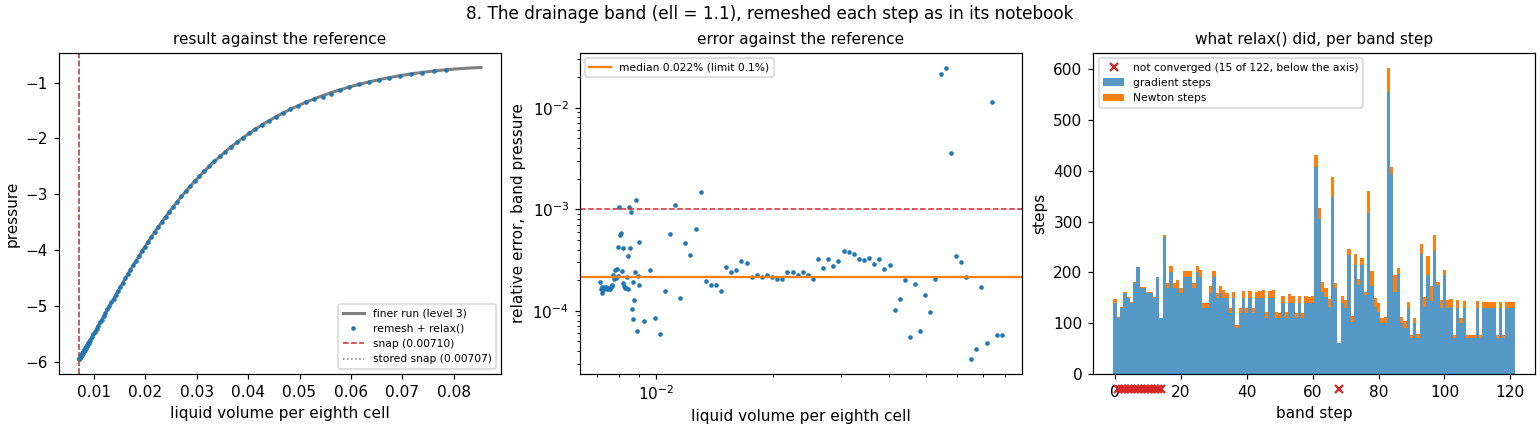
Left, the band pressure against the finer run, down to the snap. Middle, the error against it, with the median and its limit. Right, what relax() did after each band step’s remeshing (crosses below the axis: not converged).
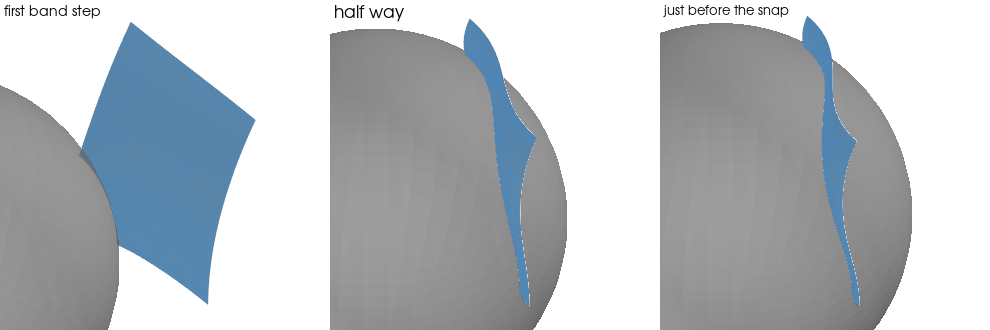
The band (blue) on the bead (grey) at the first band step, half way, and just before the snap.
A cube inflated a hundredfold
The sample cube relaxed to a sphere and inflated to 100 times its volume: the surface stretches tenfold. Reference: the sphere’s area. The relative error must not grow.
import numpy as np
import pysurfaceevolver as pyse
from pysurfaceevolver import recipes

ev = pyse.Evolver("cube.fe")    # the sample: a unit cube that relaxes to a sphere
ev.relax(levels=2)
for step in recipes.continuation(ev, ev.body(1), [1, 10, 100]):
    sphere = (36*np.pi)**(1/3)*step.value**(2/3)
    print(f"volume {step.value:5.0f}: area {ev.total_energy:.4f}, sphere {sphere:.4f}, "
          f"error {abs(ev.total_energy/sphere - 1):.3%}")
volume     1: area 4.8523, sphere 4.8360, error 0.338%
volume    10: area 22.5227, sphere 22.4466, error 0.339%
volume   100: area 104.5410, sphere 104.1879, error 0.339%
The error stays at the coarse mesh’s 0.34%.
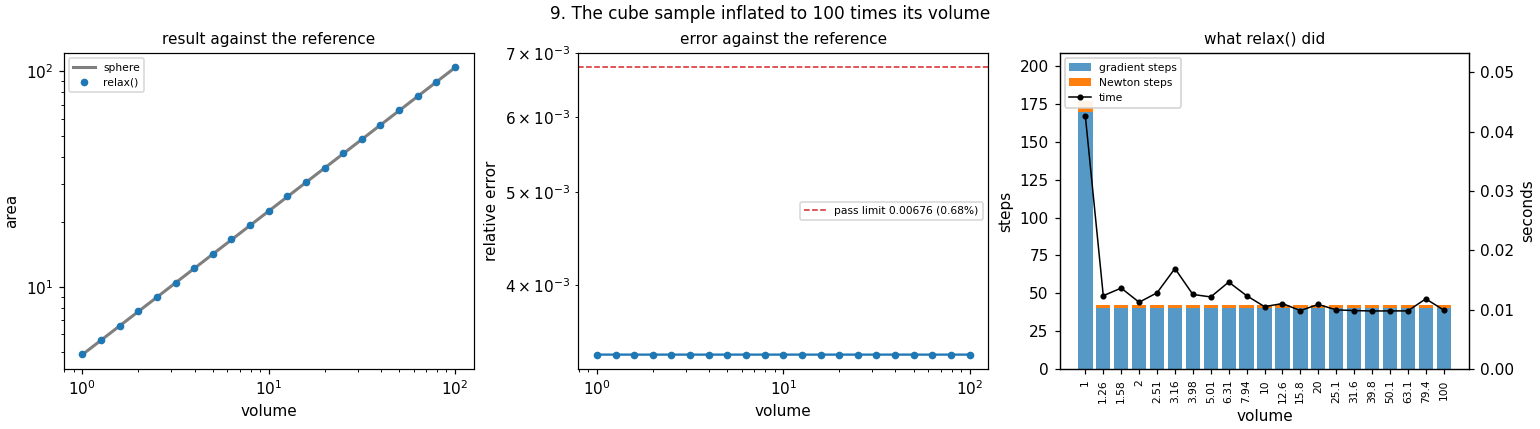
Left, the area against a sphere’s; the error stays at the starting mesh’s as the surface stretches tenfold. Middle, the error against the reference. Right, what relax() did at each step.
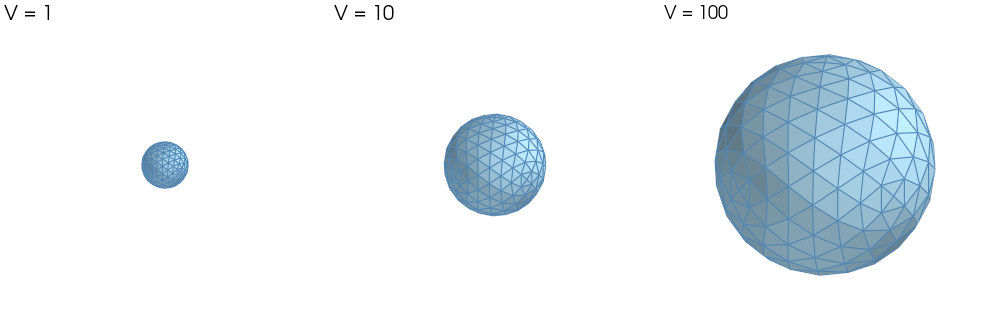
The surface at volumes 1, 10 and 100, to scale.
A gravity puddle
A drop of volume 50 with gravity (capillary length 1) and contact angle 60, started as the cap it would be without gravity, so it has to flatten a lot. Reference: the axisymmetric sessile drop with gravity; a large puddle’s height tends to 2 sin(theta/2) = 1.
import pysurfaceevolver as pyse
from pysurfaceevolver import constraints as C, shapes
from stress_helpers import cap_reference, sessile

# a drop of volume 50 with gravity (capillary length 1), contact angle 60,
# started as the cap it would be without gravity
c0 = cap_reference(50.0, 60.0)
drop = shapes.cap(c0["R"], c0["height"], nr=10, nt=48)
ev = pyse.Evolver()
ev.load_arrays(drop.vertices, drop.faces,
               constraints={1: C.plane((0, 0, 1), 0.0, contact_angle=60.0)},
               vertex_constraints={1: drop.rims["rim"]}, gravity=1,
               bodies=[pyse.Body(volume=50.0, density=1.0)])
ev.relax(levels=1)
ref = sessile(50.0, 60.0, rho_g=1.0)
print(f"height {ev.mesh().vertices[:, 2].max():.4f} (reference {ref['height']:.4f}), "
      f"energy {ev.total_energy:.4f} (reference {ref['energy']:.4f})")
height 1.0740 (reference 1.0714), energy 62.6181 (reference 62.5967)
Height and energy within 0.25%.
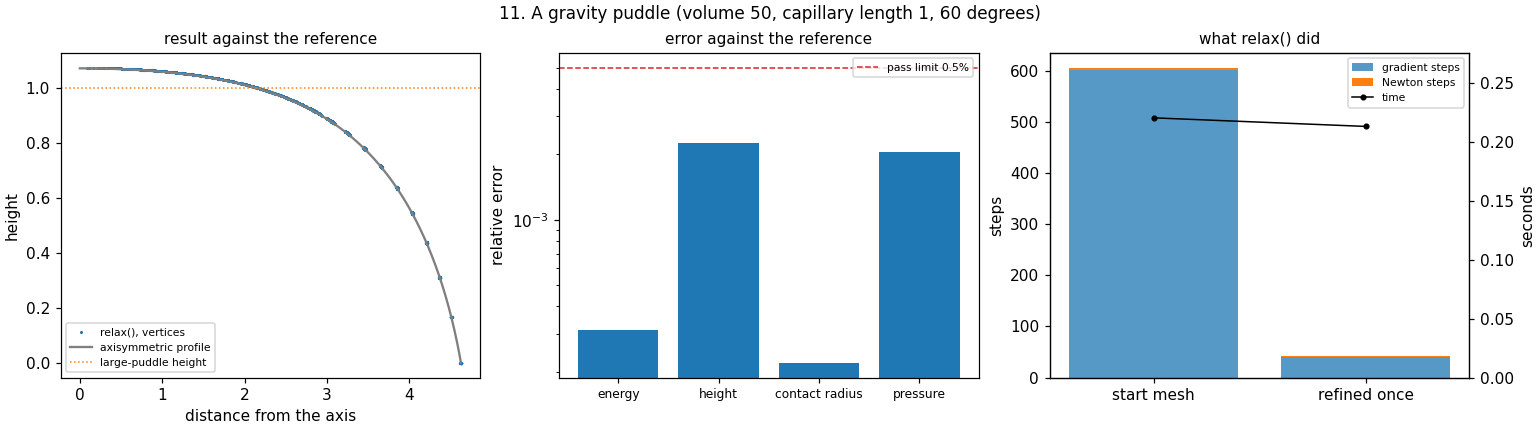
Left, the vertices against the axisymmetric profile with gravity, and the four errors (limit 0.5%). Middle, the error against the reference. Right, what relax() did at each step.
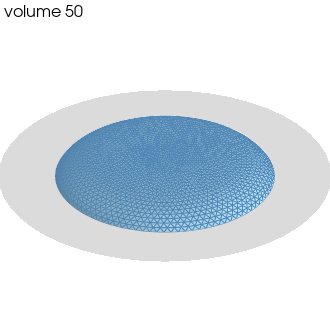
The puddle.
A drop evaporating to 1e-4 of its volume
A 60-degree cap shrinking to 1e-4 of its volume, the mesh shrinking with it. Reference: the exact cap. The error must not grow as the drop shrinks.
import numpy as np
import pysurfaceevolver as pyse
from pysurfaceevolver import constraints as C, recipes, shapes
from stress_helpers import cap_reference, contact_radius

# a 60-degree cap evaporating to 1e-4 of its volume
h = 1 - np.cos(np.radians(60.0))
drop = shapes.cap(1.0, h)
volume = np.pi*h*h*(3 - h)/3
ev = pyse.Evolver()
ev.load_arrays(drop.vertices, drop.faces,
               constraints={1: C.plane((0, 0, 1), 0.0, contact_angle=60.0)},
               vertex_constraints={1: drop.rims["rim"]}, bodies=[pyse.Body(volume=volume)])
ev.relax()
# 25 steps, each about 70% of the last (jumps of 10x are too large to follow)
for step in recipes.continuation(ev, ev.body(1), volume*np.geomspace(1, 1e-4, 25)):
    if step.index % 6:
        continue
    ref = cap_reference(step.value, 60.0)
    print(f"volume {step.value:.2e}: energy error {abs(ev.total_energy/ref['energy'] - 1):.2%}, "
          f"radius error {abs(contact_radius(ev, 1)/ref['radius'] - 1):.2%}")
volume 6.54e-01: energy error 0.15%, radius error 0.42%
volume 6.54e-02: energy error 0.15%, radius error 0.47%
volume 6.54e-03: energy error 0.14%, radius error 0.46%
volume 6.54e-04: energy error 0.15%, radius error 0.48%
volume 6.54e-05: energy error 0.15%, radius error 0.47%
The error stays near the starting mesh’s (the contact radius of the coarse rim is 0.4-0.6% off).
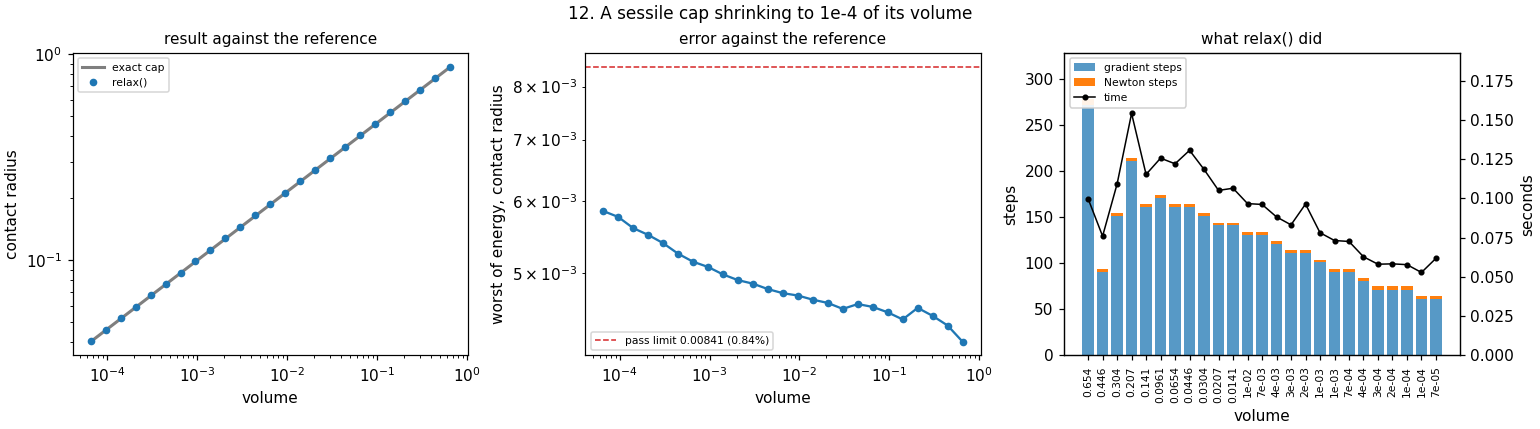
Left, the contact radius against the exact cap over four decades of volume; the error stays near the starting mesh’s. Middle, the error against the reference. Right, what relax() did at each step.
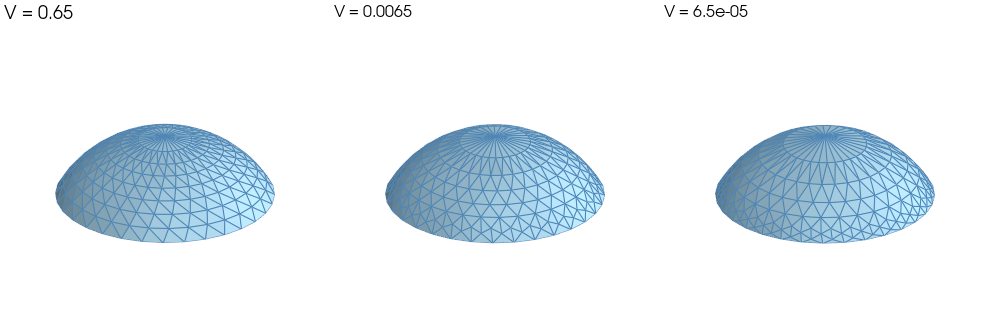
The cap at the start, at 1e-2 and at 1e-4 of its volume, each to its own scale.
Schwarz’s P and D surfaces
Two triply periodic minimal surfaces from Brakke’s online collection (included with
pySE): a fundamental region of each in a quotient space, where a symmetry group, not
a periodic box, generates the rest. Refined five times with a default relax() after
each refinement; the reference is each surface’s area per cubic unit cell, A/V^(2/3),
2.3451 (P) and 3.8377 (D), the standard values.
import pysurfaceevolver as pyse

# fundamental regions of Schwarz's P and D surfaces, from Brakke's online
# collection; 12 times their area is the area per cubic unit cell, A/V^(2/3)
for name, label, reference in (("pcell.fe", "P", 2.3451), ("dcell.fe", "D", 3.8377)):
    ev = pyse.Evolver(name)
    ev.relax()
    areas = []
    for level in range(1, 6):
        ev.refine()
        ev.relax()
        areas.append(12*ev.total_energy)
    extrapolated = (4*areas[-1] - areas[-2])/3      # second order: error / 4 per level
    print(f"{label}: {areas[-1]:.6f} after 5 refinements, extrapolated {extrapolated:.6f}, "
          f"reference {reference}")
P: 2.345166 after 5 refinements, extrapolated 2.345102, reference 2.3451
D: 3.838111 after 5 refinements, extrapolated 3.837785, reference 3.8377
The error falls fourfold per refinement (second order in the edge length), and the extrapolated areas agree with the standard values to their last digit.
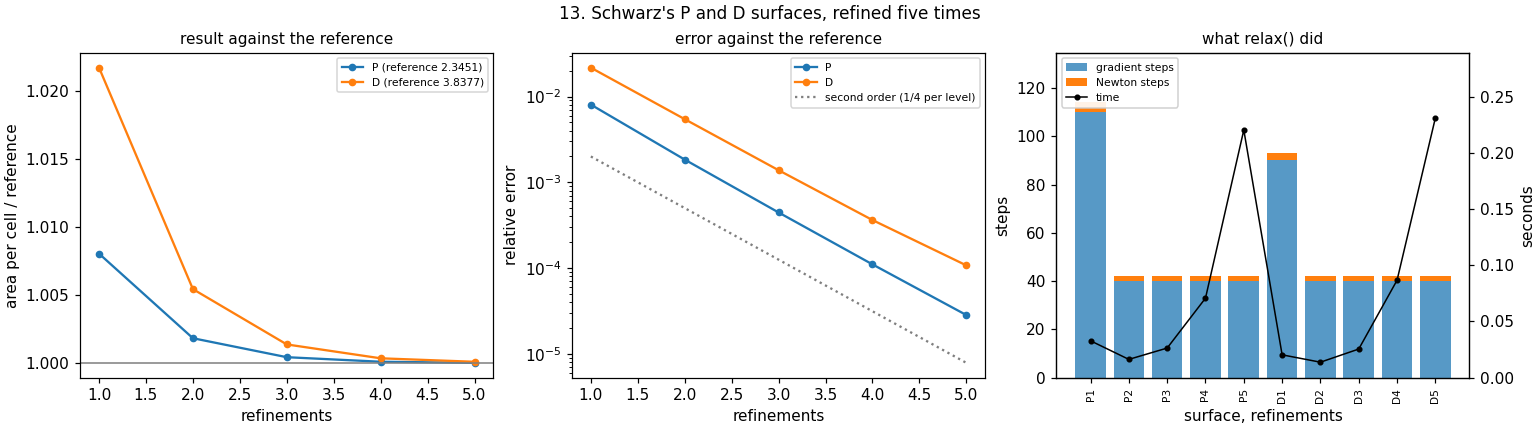
Left, the area per unit cell against the standard value at each refinement. Middle, the error, falling fourfold per refinement. Right, what relax() did.
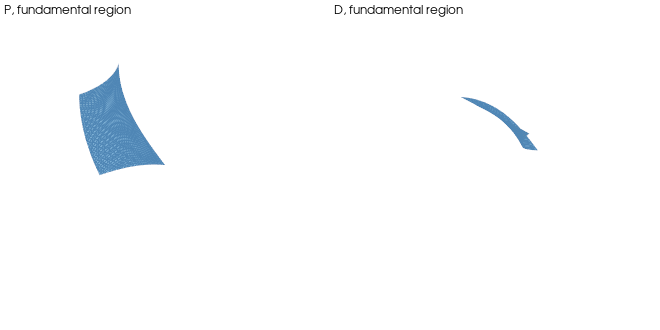
The fundamental regions after five refinements.
A drop on a sphere
A drop of volume 0.5 resting on a solid sphere of radius 1, its contact angle swept as
a parameter. Without gravity the exact shape is a spherical cap meeting the sphere at
the contact angle (drop_on_sphere in the helpers). The wetted region holds the
sphere’s north pole, where the line integrals of the wall can’t reach: the
constraint’s volconst closes the volume and ev.energy adds the wetting energy the
integrals leave out, both automatically, also with the angle as a parameter.
import numpy as np
import pysurfaceevolver as pyse
from pysurfaceevolver import constraints as C, recipes, shapes
from stress_helpers import drop_on_sphere

V = 0.5
exact = drop_on_sphere(V, 90.0)                 # start from the exact 90 degree drop
rho, a = exact["rho"], exact["radius"]
d = np.sqrt(1 + rho**2)
t = np.linspace(np.arctan2(a, np.sqrt(1 - a**2) - d), 0, 9)
drop = shapes.revolve(rho*np.sin(t), d + rho*np.cos(t), nt=24)
ev = pyse.Evolver()
ev.load_arrays(drop.vertices, drop.faces,
               constraints={1: C.sphere((0, 0, 0), 1.0, contact_angle="theta",
                                        wet_poles=("north",))},
               vertex_constraints={1: drop.rims["bottom"]}, parameters={"theta": 90.0},
               bodies=[pyse.Body(volume=V)])
ev.relax(levels=2)

for step in recipes.continuation(ev, "theta", [75, 60, 45, 30]):
    ref = drop_on_sphere(V, step.value)
    print(f"theta {step.value:2d}: energy {ev.energy:.5f} (exact {ref['energy']:.5f}), "
          f"pressure {ev.body(1).pressure:.4f} (exact {ref['pressure']:.4f}), "
          f"angle on the mesh {ev.contact_angles(1).mean():.1f}, "
          f"{'converged' if step.result.converged else 'NOT converged'}")
theta 75: energy 2.46376 (exact 2.46113), pressure 3.4788 (exact 3.4772), angle on the mesh 72.9, converged
theta 60: energy 2.17851 (exact 2.17580), pressure 3.1781 (exact 3.1767), angle on the mesh 58.7, converged
theta 45: energy 1.85060 (exact 1.84797), pressure 2.8262 (exact 2.8250), angle on the mesh 43.8, converged
theta 30: energy 1.50512 (exact 1.50271), pressure 2.4525 (exact 2.4508), angle on the mesh 28.3, converged
The energies and pressures are within 0.2% of the exact cap’s at 1,700 facets; the
contact angle measured on the mesh lags the set one by a degree or two (it is first
order in the edge length). As the contact line creeps over the sphere, gradient steps
make slow progress: once the rounds have used half of max_iter with the residual
falling by less than 5% a round, relax() tries Newton there, which converges in a
few steps. (Before that rule, the rounds used up max_iter and most steps ended
unconverged.)
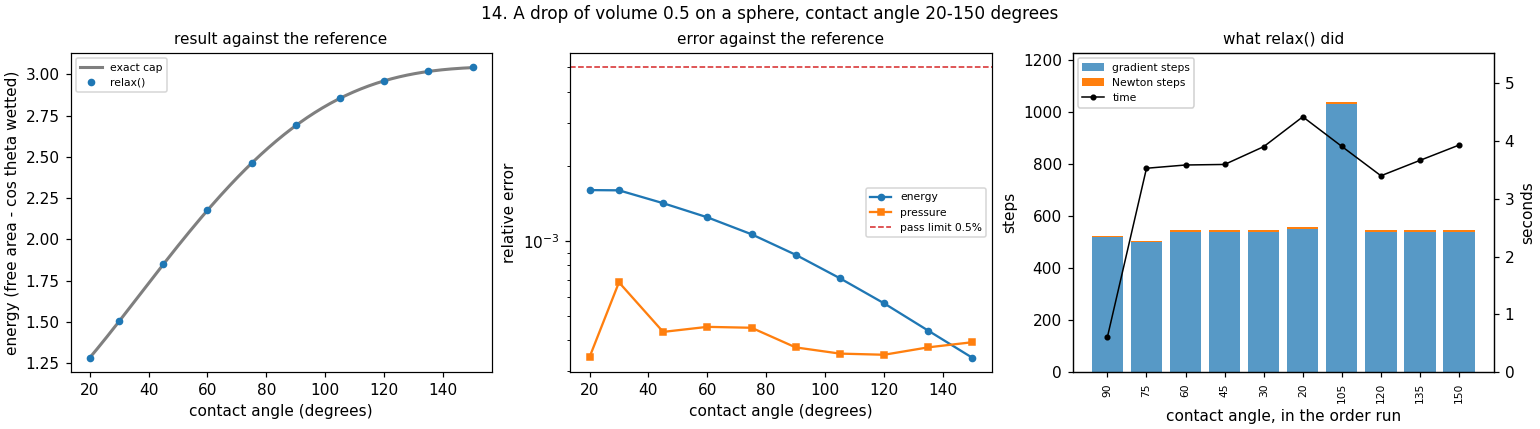
Left, the energy against the exact cap. Middle, the errors in energy and pressure (limit 0.5%). Right, what relax() did, in the order run.
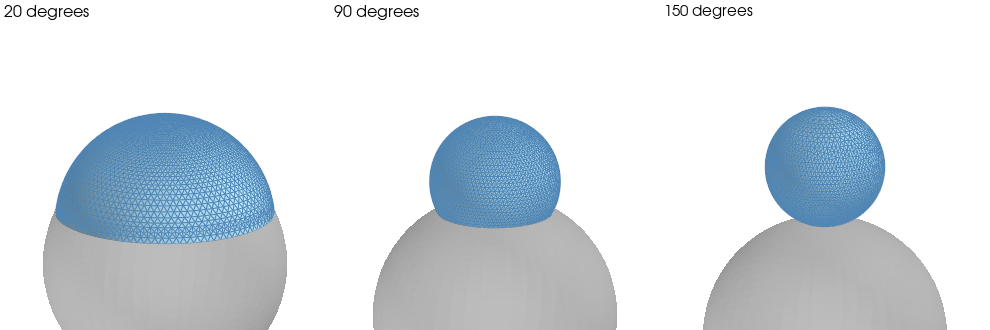
The drop at 20, 90 and 150 degrees.
A double bubble
Two unit boxes sharing a face relax to the standard double bubble: three spherical
caps meeting at 120 degrees along a circle, the shape proved to enclose two volumes
with the least area (Hutchings, Morgan, Ritoré and Ros). The second bubble then
shrinks; the reference is exact (double_bubble in the helpers). Two bodies share
the wall, so each body lists its faces.
import numpy as np
import pysurfaceevolver as pyse
from pysurfaceevolver import shapes
from stress_helpers import double_bubble

# two unit boxes side by side, sharing the face x = 1
box = shapes.box((1, 1, 1), n=2)
right = box.vertices + [1, 0, 0]
row = {tuple(np.round(p, 9)): i for i, p in enumerate(box.vertices)}
shared = np.array([row.get(tuple(np.round(p, 9)), -1) for p in right])
new = len(box.vertices) + np.cumsum(shared < 0) - 1
vertices = np.vstack([box.vertices, right[shared < 0]])
right_faces = np.where(shared >= 0, shared, new)[box.faces]
wall = np.flatnonzero(np.isclose(box.vertices[box.faces].mean(axis=1)[:, 0], 1))
right_faces = right_faces[~np.isclose(vertices[right_faces].mean(axis=1)[:, 0], 1)]
faces = np.vstack([box.faces, right_faces])
n = len(box.faces)
ev = pyse.Evolver()
ev.load_arrays(vertices, faces, bodies=[
    pyse.Body(1.0, faces=range(n)), pyse.Body(1.0, faces=list(wall) + list(range(n, len(faces))))])
ev.relax(levels=2)

for v2 in [1.0, 0.6, 0.2]:
    ev.body(2).target = v2
    ev.relax()
    ref = double_bubble(1.0, v2)
    p = ev.bodies().pressure
    print(f"volumes 1 and {v2}: area {ev.total_area:.5f} (exact {ref['area']:.5f}), "
          f"pressures {p[0]:.4f}, {p[1]:.4f} (exact {ref['p1']:.4f}, {ref['p2']:.4f})")
volumes 1 and 1.0: area 9.15253 (exact 9.13942), pressures 3.0507, 3.0507 (exact 3.0465, 3.0465)
volumes 1 and 0.6: area 7.84328 (exact 7.83166), pressures 3.0985, 3.5491 (exact 3.0938, 3.5456)
volumes 1 and 0.2: area 6.21830 (exact 6.20805), pressures 3.1698, 4.8730 (exact 3.1640, 4.8735)
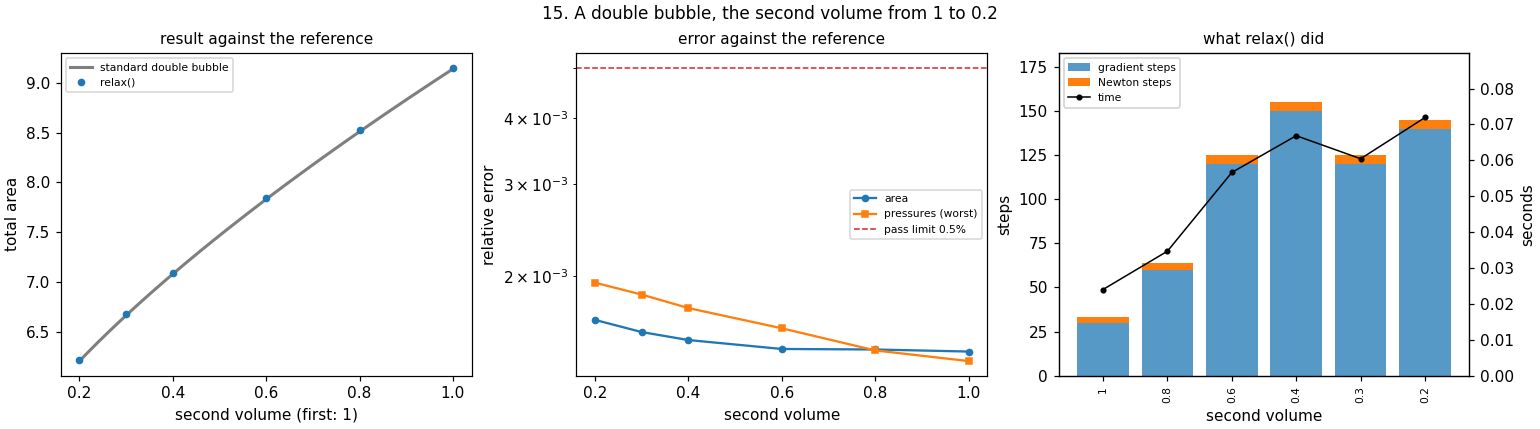
Left, the total area against the standard double bubble. Middle, the errors in area and pressures. Right, what relax() did.
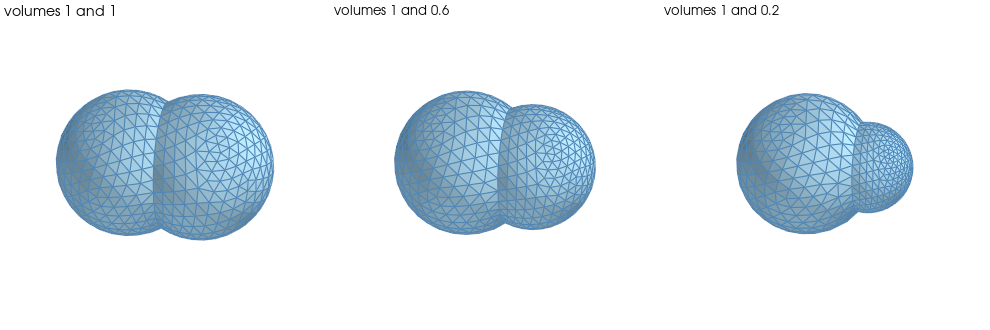
The double bubble at volume ratios 1, 0.6 and 0.2.
The force of a solder joint
The force a liquid solder joint exerts on its pad (Brakke’s bga-3.fe: pads of
radius 0.1 cm 0.12 cm apart, surface tension 480 erg/cm², gravity), from
ev.derivative with the joint stretched along with the pad. The reference is the same
joint in Brakke’s axisymmetric string model, bga-30.fe (its solder density set to
bga-3’s 9 g/cm³; it ships with 8.9, which alone moves the force by 1.3%), refined
until it converges. See Solder joints for the whole series.
import numpy as np
import pysurfaceevolver as pyse

def force(ev, axis):                     # minus dE/dheight, the joint stretched along
    h = ev.parameters["height"]
    move = lambda x: np.where(np.arange(x.shape[1]) == axis, x/h, 0.0)
    return -ev.derivative("height", method="fixed", move=move)

axi = pyse.Evolver("bga-30.fe")
axi.parameters["s_density"] = 9.0
axi.relax(levels=2)
F = []
for level in range(8):
    if level:
        axi.relax(levels=1)
    F.append(force(axi, 1))
reference = (4*F[-1] - F[-2])/3                  # second order: error / 4 per level
print(f"axisymmetric: {F[-1]:.5f} dyn at {axi.counts['edges']} edges, extrapolated {reference:.5f}")

ev = pyse.Evolver("bga-3.fe")
ev.relax(levels=2)
forces = []
for level in range(4):
    if level:
        ev.relax(levels=1)
    forces.append(force(ev, 2))
    print(f"3D, {ev.counts['facets']:5d} facets: {forces[-1]:.5f} dyn "
          f"({forces[-1]/reference - 1:+.2%})")
print(f"3D extrapolated: {(4*forces[-1] - forces[-2])/3:.5f}")
axisymmetric: 16.70464 dyn at 515 edges, extrapolated 16.70370
3D,   432 facets: 29.97050 dyn (+79.42%)
3D,  1632 facets: 19.87428 dyn (+18.98%)
3D,  6336 facets: 17.48835 dyn (+4.70%)
3D, 24960 facets: 16.89928 dyn (+1.17%)
3D extrapolated: 16.70292
Brakke’s starting meshes give a force nearly twice the converged one; both models then converge at second order, to the same force.
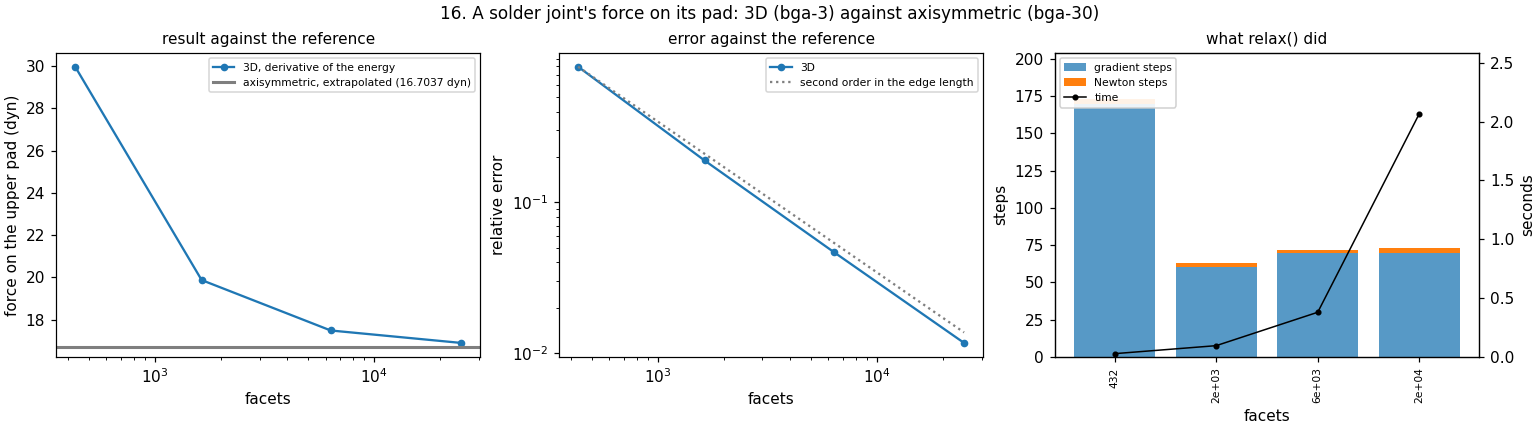
Left, the 3D force against the axisymmetric reference. Middle, its error, second order in the edge length. Right, what relax() did at each refinement.
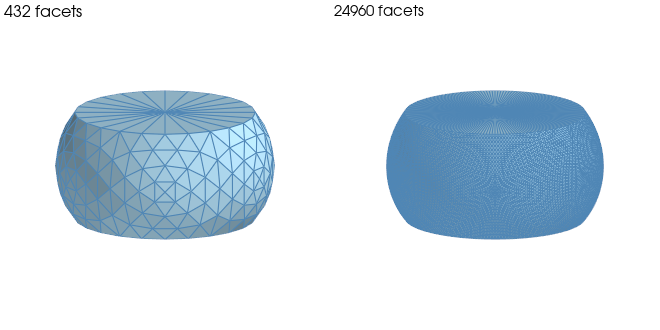
The joint on Brakke’s starting mesh and refined three times.
A catenoid between round wires, to its fold
A soap film between two round wires of radius 1, pulled apart. The wires are Evolver
boundaries (constraints.circle and constraints.curve), so refining keeps them
round, and their vertices are fixed. Past a separation of 1.3255 no catenoid spans
the wires; continuation(stop_on="unconverged") stops there and puts the last
catenoid back.
import warnings
import numpy as np
import pysurfaceevolver as pyse
from pysurfaceevolver import constraints as C, recipes, shapes

tube = shapes.tube(1.0, 0.0, 0.6, nz=4, nt=16)
top = C.curve("cos(p1)", "sin(p1)", "ht", lambda x: np.arctan2(x[:, 1], x[:, 0]))
ev = pyse.Evolver()
ev.load_arrays(tube.vertices, tube.faces, boundaries={1: C.circle(), 2: top},
               vertex_boundaries={1: tube.rims["bottom"], 2: tube.rims["top"]},
               parameters={"ht": 0.6})
ev.relax(levels=2)

def catenoid(H):                       # the exact area, wires at -H and H
    lo, hi = 1/np.cosh(1.19967864), 1.0  # the stable root of a cosh(H/a) = 1
    for _ in range(100):
        a = (lo + hi)/2
        lo, hi = (lo, a) if a*np.cosh(H/a) > 1 else (a, hi)
    return np.pi*a*(2*H + a*np.sinh(2*H/a))

with warnings.catch_warnings(record=True) as caught:
    warnings.simplefilter("always")
    for step in recipes.continuation(ev, "ht", np.arange(0.8, 1.6, 0.1), stop_on="unconverged"):
        print(f"wires {step.value:.1f} apart: area {ev.total_area:.5f} "
              f"(exact {catenoid(step.value/2):.5f})")
print([str(w.message).split(";")[0] for w in caught if "stopped" in str(w.message)])
wires 0.8 apart: area 4.88239 (exact 4.88379)
wires 0.9 apart: area 5.44628 (exact 5.44755)
wires 1.0 apart: area 5.99083 (exact 5.99180)
wires 1.1 apart: area 6.51129 (exact 6.51167)
wires 1.2 apart: area 6.99968 (exact 6.99964)
wires 1.3 apart: area 7.43958 (exact 7.43978)
['continuation() stopped before 1.4: relax() came out pinched off there']
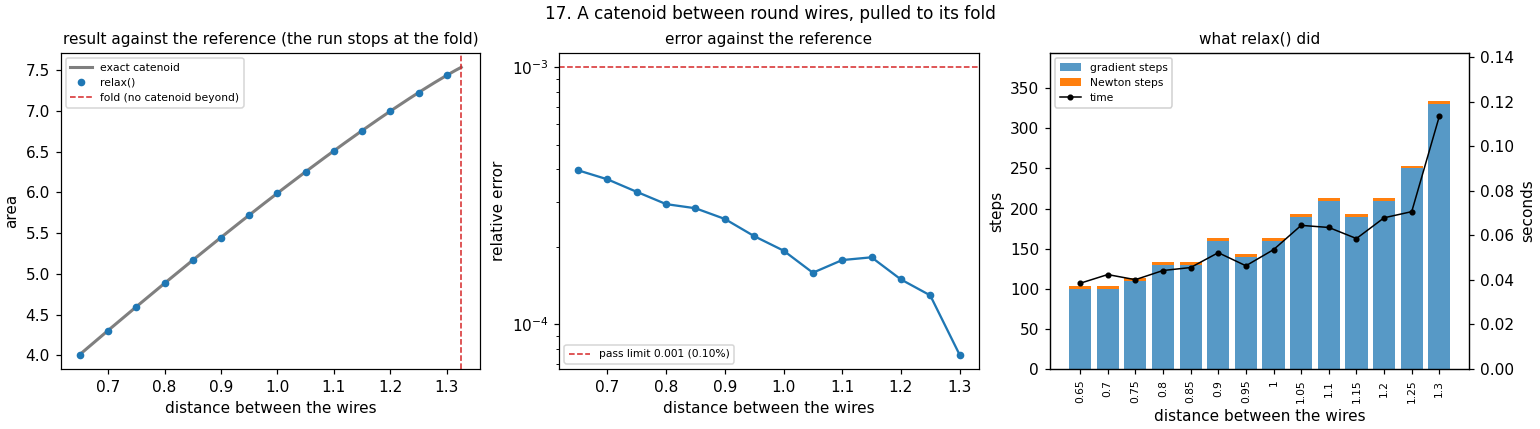
Left, the area against the exact catenoid, with the fold. Middle, the error. Right, what relax() did; the run stops at the first step past the fold.
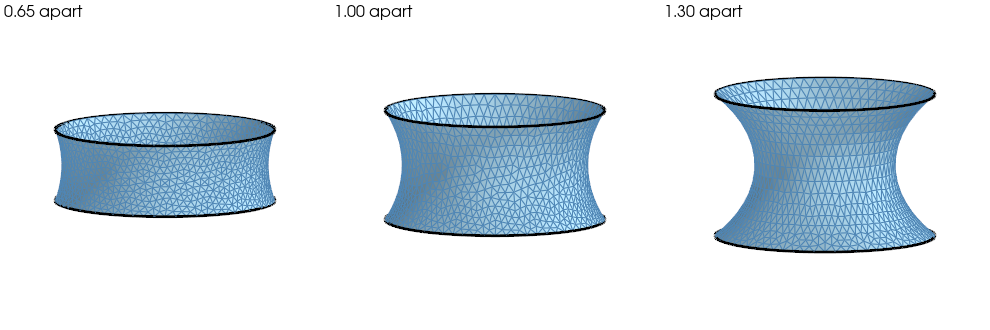
The film between the wires at three separations.
Past the fold
recipes.arclength follows the branch itself rather than the separation: each point
lies a fixed distance along the branch from the last, so the run turns at the fold
and comes back along the unstable catenoid, the one with the thinner neck. Its points
are found by Newton steps alone (gradient steps would leave an unstable branch), and
result.negative_modes counts the directions that lower the energy: none before the
fold, one after.
import numpy as np
import pysurfaceevolver as pyse
from pysurfaceevolver import constraints as C, recipes, shapes

tube = shapes.tube(1.0, 0.0, 0.6, nz=4, nt=16)
top = C.curve("cos(p1)", "sin(p1)", "ht", lambda x: np.arctan2(x[:, 1], x[:, 0]))
ev = pyse.Evolver()
ev.load_arrays(tube.vertices, tube.faces, boundaries={1: C.circle(), 2: top},
               vertex_boundaries={1: tube.rims["bottom"], 2: tube.rims["top"]},
               parameters={"ht": 0.6})
ev.relax(levels=2)

def catenoid(H, stable):               # the exact area, wires at -H and H
    a_fold = H/1.19967864               # a*cosh(H/a) = 1 has two roots up to the fold
    lo, hi = (a_fold, 1.0) if stable else (1e-3, a_fold)
    for _ in range(100):
        a = (lo + hi)/2
        lo, hi = (lo, a) if (a*np.cosh(H/a) > 1) == stable else (a, hi)
    return np.pi*a*(2*H + a*np.sinh(2*H/a))

for step in recipes.arclength(ev, "ht", 0.05, 40):
    if step.index % 5 == 0:
        modes = step.result.negative_modes
        exact = catenoid(step.value/2, modes == 0) if step.value < 1.3255 else float("nan")
        print(f"wires {step.value:.4f} apart: area {step.energy:.5f} (exact {exact:.5f}), "
              f"negative modes {modes}")
wires 0.6000 apart: area 3.70990 (exact 3.71143), negative modes 0
wires 0.8455 apart: area 5.14115 (exact 5.14237), negative modes 0
wires 1.0843 apart: area 6.43144 (exact 6.43177), negative modes 0
wires 1.2996 apart: area 7.43873 (exact 7.43826), negative modes 0
wires 1.1858 apart: area 7.17625 (exact 7.17707), negative modes 1
wires 0.9688 apart: area 6.79914 (exact 6.80090), negative modes 1
wires 0.7568 apart: area 6.55847 (exact 6.56035), negative modes 1
wires 0.5491 apart: area 6.41272 (exact 6.41052), negative modes 1
Both branches match the exact areas within 0.04%. Between points the vertices are spread along the surface and edges flipped (Newton steps move vertices only along the normal); the mesh is otherwise fixed, so as the neck thins its facets shrink, and the run stops with a warning once the mesh can’t keep up: refine first for a long run. Where a shrinking bridge breaks follows a liquid bridge between spheres the same way, and finds it turning unstable before its fold.