Brakke’s samples: quadratic and Lagrange elements
Curved elements: the quadratic model (edges with midpoints) and Lagrange elements of
higher order, a short final stage on a mesh settled in the linear model. relax() in
those models first does what the manual recommends, five gradient steps and then
Newton steps.
Each sample is run twice from its datafile: once with the recipe Brakke wrote into
it (its gogo command, or the usage its comments describe), once with a default
ev.relax() given as many refinements as the recipe does (levels). The table
shows the energy each ends with, the residual (how far from equilibrium, see
Relaxing a surface), the facet count, the time, and what relax()
reports: converged, stable, and any health issues. A lower energy on the same mesh
is not always the better answer: a coarse mesh can lower its energy in ways the
smooth surface can’t, so where an exact value is known, the error against it is
the measure. Times are from the documentation build and vary.
This gallery assumes Getting started and Relaxing a surface; its pages can be read in any order.
import numpy as np
import pyvista as pv
import pysurfaceevolver as pyse
import brakke_helpers as bh

pv.set_jupyter_backend("static")
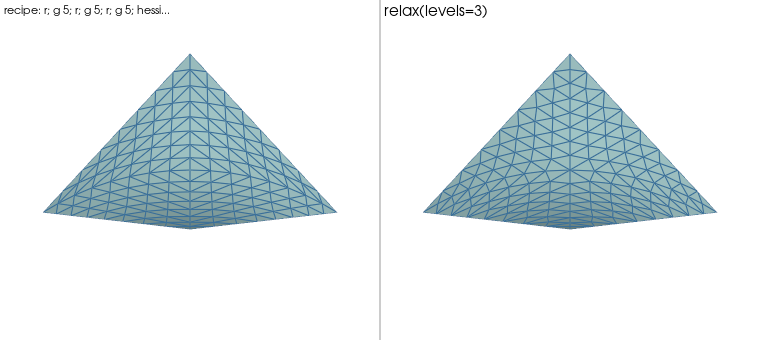
quad.fe: a skew quadrilateral
A film on a skew quadrilateral wire in the quadratic model.
print(bh.recipe("quad.fe"))
runs = bh.compare("quad.fe")
bh.show(runs)
r; g 5; r; g 5; r; g 5; hessian; hessian;
| energy | residual | facets | seconds | converged | stable | notes | |
|---|---|---|---|---|---|---|---|
| recipe: r; g 5; r; g 5; r; g 5; hessian; hessian; | 4.318202947 | 2.6e-11 | 256 | 0.00 | |||
| relax(levels=3) | 4.318322217 | 4.6e-11 | 256 | 0.01 | yes | yes |
qmound.fe: the drop on a table, quadratic
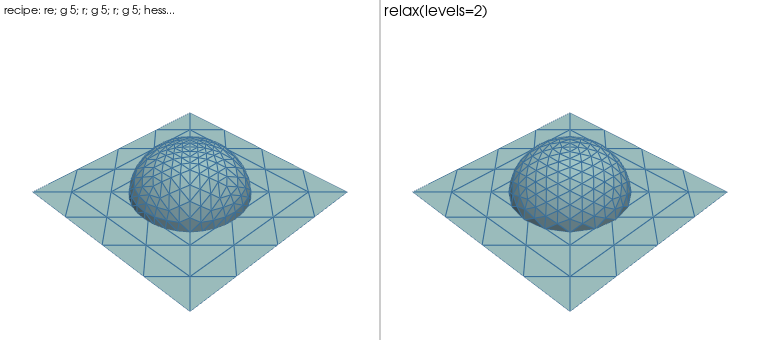
mound.fe in the quadratic model, its volume a named quantity.
print(bh.recipe("qmound.fe"))
runs = bh.compare("qmound.fe")
bh.show(runs)
re; g 5; r; g 5; r; g 5; hessian; hessian;
| energy | residual | facets | seconds | converged | stable | notes | |
|---|---|---|---|---|---|---|---|
| recipe: re; g 5; r; g 5; r; g 5; hessian; hessian; | 4.12755008 | 2.8e-05 | 448 | 0.09 | |||
| relax(levels=2) | 4.127333992 | 8.9e-09 | 384 | 0.41 | yes | yes |
The Lagrange ladders of cube.fe and catman.fe
cube.fe’s gogo2 refines twice in the linear model, then switches to Lagrange
elements of order 2, 4 and 6 with g 5; hessian at each. The same with relax():
relax with two refinements, then for each order ev.set_model("lagrange", n) and
relax.
import time

def ladder(name, orders, levels=2, setup=None):
    ev = pyse.Evolver(name)
    if setup:
        setup(ev)
    t = time.perf_counter()
    ev.relax(levels=levels)
    for n in orders:
        ev.set_model("lagrange", n)
        r = ev.relax()
    return bh.Run(f"relax ladder, orders {orders}", ev.total_energy, r.residual,
                  ev.counts["facets"], time.perf_counter() - t, r.converged, r.stable, [],
                  ev.mesh())

print(bh.recipe("cube.fe", "gogo2"))
cube = [bh.run_recipe("cube.fe", "gogo2", label="recipe: gogo2"), ladder("cube.fe", (2, 4, 6))]
bh.table(cube, reference=(36*np.pi)**(1/3))
g 5; r; g 5; hessian; r; g 5; hessian; lagrange 2; g 5; hessian; lagrange 4; g 5; hessian; lagrange 6; g 5; hessian; ideal_rad := (3*body[1].volume/4/pi)^(1/3); printf "Area error: %g\n",total_area - 4*pi*ideal_rad^2; printf "Vertex radius spread: %g\n", max(vertex,sqrt((x-.5)^2+(y-.5)^2+(z-.5)^2)) - min(vertex,sqrt((x-.5)^2+(y-.5)^2+(z-.5)^2));
| energy | error | residual | facets | seconds | converged | stable | notes | |
|---|---|---|---|---|---|---|---|---|
| recipe: gogo2 | 4.835975862 | +4.44e-16 | 5.3e-11 | 384 | 0.50 | |||
| relax ladder, orders (2, 4, 6) | 4.835975862 | +2.22e-16 | 1.9e-11 | 384 | 0.67 | yes | yes |
At order 6 both match the sphere’s area to rounding error (the recipe’s own check prints an area error of about 1e-15): sixth-order elements on this mesh represent the sphere essentially exactly.
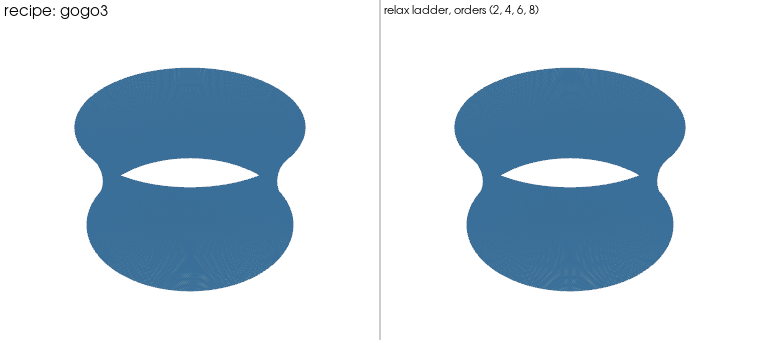
catman.fe’s gogo3 goes up to order 8. It sets rmax := cosh(height) and compares
with the area of a catenoid through rings of radius \(\cosh(0.55)\), but rmax is a
parameter of cat.fe: in catman.fe the rings keep radius 1, so its printed
“Difference from true area” compares with the wrong catenoid. The exact catenoid for
rings of radius 1 at \(\pm 0.55\) has area 6.5116735 (from \(a \cosh(0.55/a) = 1\)).
lo, hi = 0.6, 1.0                   # the larger root of a cosh(0.55/a) = 1: the stable catenoid
for _ in range(100):
    a = (lo + hi)/2
    lo, hi = (lo, a) if a*np.cosh(0.55/a) > 1 else (a, hi)
exact = np.pi*a*(2*0.55 + a*np.sinh(2*0.55/a))
print(f"exact catenoid area {exact:.10f}")
catman = [bh.run_recipe("catman.fe", "gogo3", label="recipe: gogo3"),
          ladder("catman.fe", (2, 4, 6, 8))]
bh.table(catman, reference=exact)
bh.show(catman)
exact catenoid area 6.5116735251
| energy | error | residual | facets | seconds | converged | stable | notes | |
|---|---|---|---|---|---|---|---|---|
| recipe: gogo3 | 6.511673526 | +1.58e-10 | 3.7e-11 | 384 | 1.60 | |||
| relax ladder, orders (2, 4, 6, 8) | 6.511673526 | +1.58e-10 | 3.6e-11 | 384 | 1.73 | yes | yes |
Next
The tutorial uses the same Lagrange ladder as a final stage for a
double bubble built from arrays, and Performance times it on large
surfaces. The API reference documents set_model and relax.